

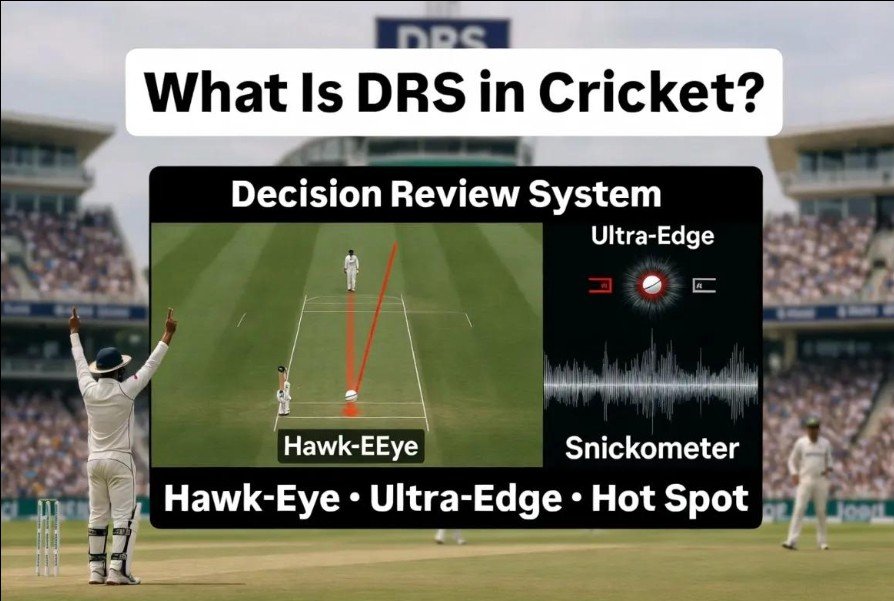
Cricket dekhte waqt aapne bahut baar dekha hoga — batsman out diya jata hai, aur captain turant apne haathon se “T” shape banata hai. Yeh hai DRS ka moment — jo aksar match ka sabse tense aur exciting hissa hota hai. Is article mein hum DRS Rule ko simple tarike se samjhenge — yeh kya hai, kaise kaam karta hai, aur iske rules kya hain.
DRS Rule Kya Hai?
DRS Rule (Decision Review System) ek technology-based system hai jo players ko on-field umpire ke decision ko challenge karne ka mauka deta hai. Agar koi team samajhti hai ki umpire ne galat decision diya hai — jaise wrongly out diya, ya wrongly not-out diya — to woh review maang sakti hai.
Yeh system 2008 mein ICC ne introduce kiya tha, sabse pehle India-Sri Lanka Test series mein trial ke roop mein. Uske baad yeh 2011 mein ODI aur 2017 mein T20I cricket mein bhi laaya gaya.
DRS Rule Mein Kaunsi Technology Use Hoti Hai?

DRS Rule akela ek technology nahi, balki multiple technologies ka combination hai:
1. Ball-Tracking (Hawk-Eye) Yeh six cameras use karke ball ki trajectory track karta hai, bowler ke haath se lekar impact point tak. Phir computer predict karta hai ki agar batsman aage na hota, to ball stumps se takrati ya nahi — yeh mainly LBW decisions ke liye use hota hai.
2. UltraEdge / Snickometer Yeh ek sensitive microphone use karta hai jo bat aur ball ke beech ka faint contact detect karta hai — sound wave pe ek “spike” dikhata hai jab ball bat ko chhoti hai, jo caught behind appeals mein help karta hai.
3. Hot Spot Infrared cameras use karke yeh dikhata hai ki ball bat ya pad se touch hui ya nahi — jab contact hota hai, thodi si heat generate hoti hai jo screen pe white spot ke roop mein dikhti hai.
DRS Kaise Use Karte Hain? Step-by-Step
- Decision aata hai – Umpire koi decision deta hai (jaise LBW out, ya caught behind)
- “T” Signal – Fielding captain (agar “not out” challenge karna hai) ya batsman khud (agar “out” challenge karna hai) apne haathon se “T” shape banata hai
- 15-Second Timer – Yeh signal dena hota hai sirf 15 seconds ke andar, jab se ball “dead” hui hai
- Third Umpire Check Karta Hai – Third umpire replays aur technology (Hawk-Eye, UltraEdge, Hot Spot) use karke decision analyze karta hai
- Final Decision – Third umpire apna findings on-field umpire ko relay karta hai, jo phir apna original decision maintain karta hai ya reverse kar deta hai
Kitne Reviews Milte Hain?
Format ke hisaab se reviews ki sankhya alag hoti hai:
| Format | Unsuccessful Reviews Per Innings |
|---|---|
| Test Matches | 2 |
| ODI | 1 |
| T20I | 1 |
Important baat: agar review successful hota hai (matlab decision overturn ho jata hai), to team apna review nahi khoti — sirf unsuccessful reviews hi count hote hain.
“Umpire’s Call” Kya Hai? (Sabse Confusing Rule)
Yeh DRS Rule in Cricket ka sabse zyada debate hone wala rule hai. Ball-tracking technology ek prediction hai, 100% certainty nahi — isliye ismein thodi margin of error hoti hai.
Rule: Agar predicted path ke mutabik ball 50% se kam stumps ko hit kar raha hai, to on-field umpire ka original decision hi maintain rehta hai — chahe woh out ho ya not-out. Isse “Umpire’s Call” kehte hain.
Example: Agar batsman LBW out diya gaya tha, aur review mein ball sirf halka sa stumps ko clip kar raha hai (50% se kam), to woh out hi rahega — kyunki original decision “Umpire’s Call” ke through protect hoti hai.
Kya Sab Kuch Review Ho Sakta Hai?
Nahi. DRS Rule sirf specific decisions ke liye use hota hai — mainly LBW aur caught dismissals. International cricket mein wide balls aur no-balls (kuch exceptions ke saath) review nahi ho sakte.
Interesting baat: IPL mein rules thode different hain — yahan players wide balls ke liye bhi review maang sakte hain, jabki international cricket mein yeh allowed nahi hai. 2026 season mein BCCI ne is rule ko aur bhi refine kiya hai, especially bowling team ke reviews ke around.
DRS Rule Ke Fayde Aur Nuksaan
Fayde:
- Clear umpiring errors correct hote hain
- Players ko fairness ka confidence milta hai
- Fans ke liye bhi exciting hota hai — tense moments create karta hai
Criticism:
- Kuch experts (jaise former umpire Dickie Bird) ne kaha hai ki yeh on-field umpires ki authority kam karta hai
- “Umpire’s Call” wala rule fans ke liye confusing hota hai
- Match ka time thoda badh jata hai reviews ki wajah se
Data ke mutabik, average 1.4 batting overturns aur 1.2 bowling overturns per match hote hain — jo dikhata hai ki DRS zyada dismissals create nahi karta, balki sirf clear errors correct karta hai.
Frequently Asked Questions
Q: DRS full form kya hai?
A: DRS ka full form hai Decision Review System.
Q: DRS Rule kab introduce hua tha?
A: DRS pehli baar 2008 mein Test cricket mein use hua (India vs Sri Lanka), 2011 mein ODI mein, aur 2017 mein T20I cricket mein introduce kiya gaya.
Q: Test match mein kitne DRS reviews milte hain?
A: Test cricket mein har team ko 2 unsuccessful reviews per innings milte hain, jabki ODI aur T20I mein sirf 1.
Q: Umpire’s Call ka matlab kya hai?
A: Jab ball-tracking technology dikhati hai ki ball 50% se kam stumps ko hit kar raha hai, to original on-field decision hi maintain rehta hai — isse Umpire’s Call kehte hain.
Q: Kya wide ball ke liye DRS le sakte hain?
A: International cricket mein nahi, lekin IPL mein players wide balls ke liye bhi review maang sakte hain — yeh ek key difference hai IPL aur international rules mein.
Q: Kya review lene ke baad team apna review khoti hai?
A: Sirf tab jab review unsuccessful ho (original decision maintain rahe). Agar decision overturn ho jaye, to team apna review nahi khoti.
Related Reads
- How Many Creases Are There in Cricket? A Complete Detailed Guide
- मुंबई इंडियंस का बाप कौन है?
- KKR का बाप कौन है?
- Virat Kohli vs Babar Azam: Full Career Stats Comparison (2026 Updated)
- Sunrisers Hyderabad vs Mumbai Indians Timeline: Full Head-to-Head History
Conclusion
DRS ne cricket ko pehle se kaafi zyada fair banaya hai — jo clear umpiring errors pehle match ka outcome badal dete the, ab technology ki madad se correct ho jate hain. Chahe “Umpire’s Call” wala rule kitna bhi confusing kyun na lage, overall DRS ne game mein transparency aur players ka confidence dono badhaya hai. Agli baar jab aap woh “T” signal dekhein, ab aap exactly jaante hain ki agle 30 seconds mein kya hone wala hai.
