

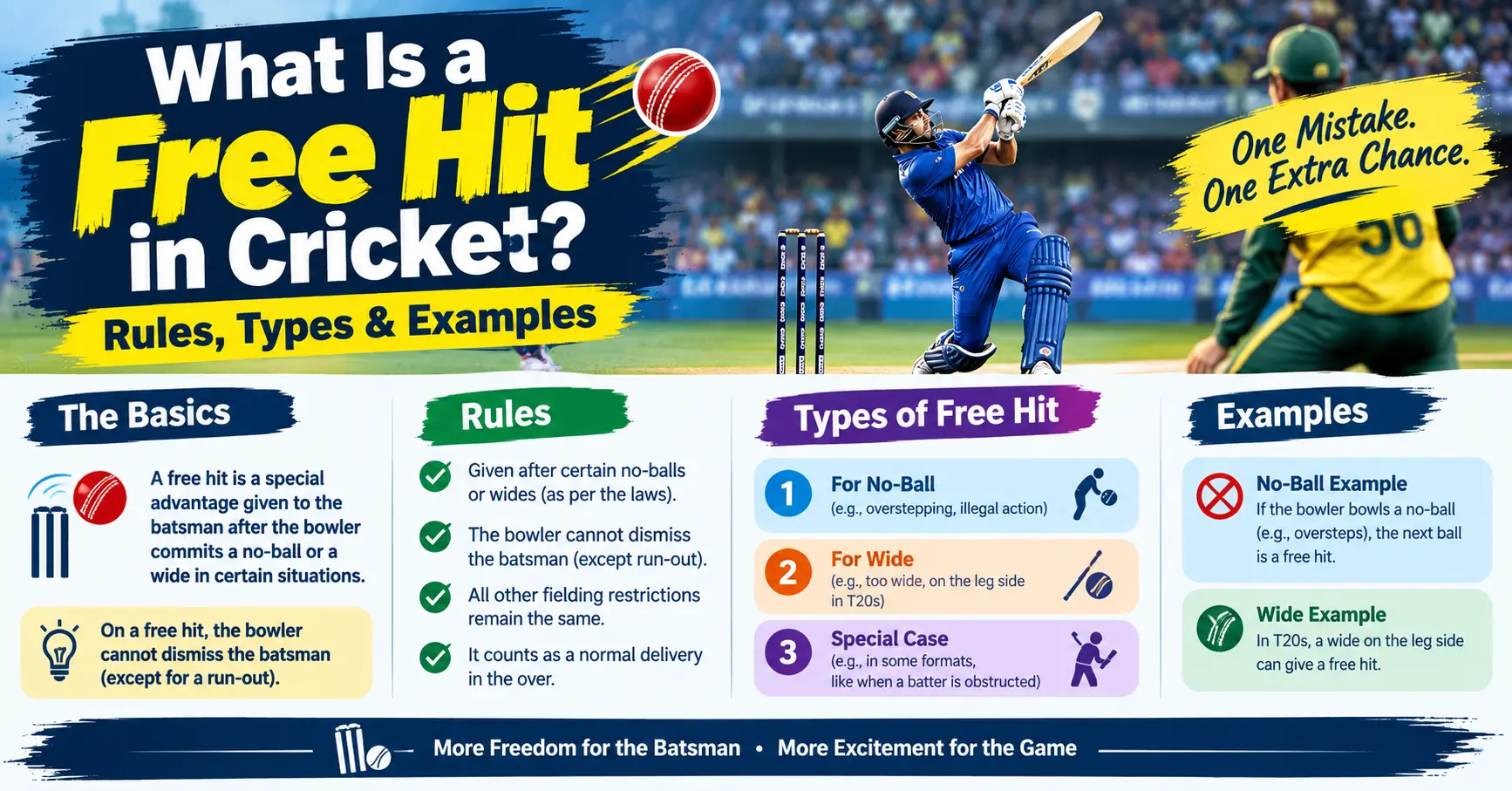
A free hit in cricket is a delivery on which the batter cannot be dismissed by most common methods of dismissal. It is awarded after certain types of no-balls, giving the batter an additional attacking opportunity.
During a free hit, the batter can still score runs through boundaries, running between the wickets, or extras. However, a free hit does not mean that the batter is completely immune from dismissal. A batter can still be dismissed in specific ways, such as run out, stumped in certain circumstances, or obstructing the field, depending on how the dismissal occurs and the applicable playing conditions.
Free hits are especially important in limited-overs cricket, including ODIs and T20 matches, where one delivery can significantly change the momentum of an innings.
What Is a Free Hit in Cricket?
A free hit in cricket is the next delivery after a qualifying no-ball. The batter faces the delivery knowing that they cannot normally be dismissed by methods such as bowled, caught, LBW, or hit wicket.
The main purpose of the free-hit rule is to prevent a bowler from gaining too much advantage from a no-ball. Since the previous delivery was illegal, the batting side receives an extra opportunity to attack on the following delivery.
Simple Example
Suppose a bowler delivers a no-ball because they overstep the popping crease.
The batter hits that no-ball for one run.
The next delivery is a free hit.
If the batter attempts a big shot and the ball is caught by a fielder, the batter is generally not out caught because a catch is not a valid dismissal on a free hit.
However, if the batter hits the ball and attempts to take a second run but is run out, the batter can still be dismissed run out.
When Is a Free Hit Awarded?
A free hit is generally awarded after a no-ball in limited-overs cricket when the competition’s playing conditions specify that the next delivery is a free hit.
The most common situation is a bowler overstepping the popping crease.
For example:
- The bowler delivers the ball.
- Their front foot lands beyond the popping crease.
- The umpire calls a no-ball.
- The no-ball penalty is added to the batting team’s score.
- The next delivery is designated as a free hit.
The exact free-hit provisions can depend on the format and tournament playing conditions, so official competition regulations should be checked for a specific match.
Why Was the Free-Hit Rule Introduced?
A no-ball already gives the batting team an extra run and an additional delivery. In limited-overs cricket, however, a no-ball can also create a strong wicket-taking opportunity for the bowler if the batter attacks the following delivery.
The free-hit concept reduces that advantage.
It encourages batters to attack while also making bowlers more careful about avoiding no-balls.
This is one reason free hits have become a major tactical part of modern white-ball cricket.
What Can a Batter Do on a Free Hit?
A free hit does not restrict the batter’s shot selection.
The batter can:
- Defend the ball
- Play a drive
- Pull or hook a short delivery
- Attempt a sweep
- Play a lofted shot
- Run between the wickets
- Hit a four
- Hit a six
- Attempt a risky attacking shot
The batter is not required to attack simply because it is a free hit.
A smart batter may also choose to play safely if the field placement makes an attacking shot risky.
Can You Get Out on a Free Hit?
Yes. A batter can still be dismissed on a free hit, but only by dismissal methods that are permitted under the Laws and relevant playing conditions.
This is one of the biggest misconceptions about free hits.
A free hit does not mean “the batter cannot get out.”
Common dismissals that generally do not apply
On a normal free-hit delivery, the batter cannot be dismissed by:
- Bowled
- Caught
- LBW
- Hit wicket
because these dismissal methods are not available for the free-hit delivery under the relevant free-hit provision.
Dismissals that can still happen
Depending on the circumstances, a batter can still be dismissed by methods such as:
- Run out
- Stumped, where the relevant conditions for stumping are satisfied
- Obstructing the field
The exact circumstances matter. For example, a stumping dismissal involves specific requirements under the Laws and is not simply the same as saying that every missed free-hit ball can produce a stumping.
Can You Be Bowled on a Free Hit?
No, a batter cannot normally be dismissed bowled on a free hit.
If the bowler’s delivery hits the stumps and the batter has not otherwise been dismissed, the free-hit protection means the batter is not out bowled.
This can create some dramatic moments.
For example, imagine a batter attempts a big shot on a free hit, misses the ball, and the ball hits the stumps.
On an ordinary delivery, this would normally be bowled.
On a free hit, however, bowled is not a valid dismissal.
Can You Be Caught on a Free Hit?
No, a batter cannot normally be dismissed caught from a free-hit delivery.
Suppose the batter hits the ball high in the air and a fielder takes a clean catch.
On an ordinary legal delivery, the batter would be out caught.
But if it is a free hit, the catch does not result in a caught dismissal.
The batter can continue the innings, subject to any other event occurring during the play.
Can You Be LBW on a Free Hit?
No, LBW is not available as a dismissal on a free-hit delivery.
This is particularly important because batters sometimes take greater risks on free hits.
If the ball strikes the batter’s pad and the normal LBW conditions would otherwise appear to be satisfied, the batter is not given out LBW on the free-hit delivery.
If you want to understand how LBW normally works, see our detailed guide to the LBW rule in cricket.
Can You Be Run Out on a Free Hit?
Yes. A batter can be run out on a free hit.
This is one of the most important exceptions.
Imagine that a batter hits the ball into the outfield and attempts to take two runs.
The fielding side quickly collects the ball and breaks the stumps before the batter makes their ground.
The batter can be run out, even though the delivery was a free hit.
Therefore, batters cannot assume that they are completely safe.
Can You Be Stumped on a Free Hit?
Stumping on a free hit is more complicated than many fans assume.
A stumping dismissal has specific requirements under the Laws of Cricket. It generally involves the wicketkeeper putting down the wicket while the batter is out of their ground and is not attempting a run.
However, the free-hit rule interacts with the type of delivery and the relevant dismissal law. Therefore, whether a particular stumping is possible depends on the exact circumstances.
This is why simply saying “stumping is always allowed on a free hit” or “stumping is never allowed on a free hit” can be misleading.
Can a Batter Hit a Six on a Free Hit?
Yes.
A batter can hit a six on a free hit just like on any other delivery.
In fact, free hits often encourage aggressive batting because the risk of losing the wicket through several common dismissal methods is removed.
For example:
No-ball → Free hit → Six
The batting side could receive:
- The no-ball penalty
- Runs scored from the bat
- Six runs if the ball is hit over the boundary without bouncing
The exact total depends on what happened on the no-ball and free-hit deliveries.
Does a Free Hit Count as a Ball in the Over?
A free hit can count as a legal delivery if the free-hit delivery itself is legal.
For example:
No-ball → free hit
The no-ball does not count as one of the six legal balls in an over.
If the free-hit delivery is legal, it counts as one legal delivery.
But if the bowler bowls another no-ball or a wide on the free-hit delivery, the over continues and another delivery is required.
Example
Imagine the sixth ball of an over is a no-ball.
The next delivery is a free hit.
If the free-hit delivery is legal, it is the next legal ball of the over.
If the bowler bowls another no-ball, that delivery does not count as a legal ball, and another delivery is required.
What Happens If Another No-Ball Is Bowled on a Free Hit?
A free-hit delivery can itself be a no-ball.
If the bowler bowls another no-ball, the batting side receives the applicable no-ball penalty and the next delivery remains a free hit under the relevant playing conditions.
So the sequence can continue:
No-ball → Free Hit → No-ball → Free Hit
This can put considerable pressure on the bowler.
The bowler must regain control and deliver a legal ball while preventing the batter from scoring heavily.
What Happens If a Wide Is Bowled on a Free Hit?
If the bowler bowls a wide on a free-hit delivery, the batting team receives the applicable wide-ball penalty.
The delivery is not counted as a legal ball.
The free-hit status continues for the next delivery under the applicable playing conditions.
This means a bowler cannot escape the free-hit situation simply by bowling a wide.
Free Hit vs No-Ball
These two terms are related but they are not the same thing.
| Feature | No-Ball | Free Hit |
|---|---|---|
| What is it? | An illegal delivery | Special next delivery after a qualifying no-ball |
| Extra run | Yes, under applicable rules | Not automatically |
| Counts as legal ball? | No | Yes, if it is a legal delivery |
| Batter can hit a six? | Yes | Yes |
| Batter can be caught? | Depends on the specific no-ball circumstances and Laws | Not out caught on the free-hit delivery |
| Batter can be LBW? | Generally no-balling restrictions apply | Not out LBW |
| Batter can be run out? | Yes, in applicable circumstances | Yes |
| Main purpose | Penalize an illegal delivery | Give batting side protection on the following delivery |
The key point is:
A no-ball is the reason a free hit may be awarded; a free hit is the following delivery.
Free Hit vs Legal Delivery
A normal legal delivery gives the bowler access to the standard dismissal methods, subject to the Laws.
A free hit removes several common dismissal possibilities.
| Situation | Normal Legal Delivery | Free Hit |
|---|---|---|
| Bowled | Possible | Not possible as a dismissal |
| Caught | Possible | Not possible as a dismissal |
| LBW | Possible | Not possible as a dismissal |
| Run out | Possible | Possible |
| Hit wicket | Possible | Not possible as a dismissal |
| Six | Possible | Possible |
| Four | Possible | Possible |
This difference makes the free hit a unique tactical situation.
Does a Free Hit Give the Batter an Extra Run?
No.
The free hit itself does not automatically add a run to the batting team’s score.
The extra run comes from the no-ball, not from the free-hit designation.
For example:
- Bowler bowls a no-ball → 1 no-ball extra
- Next delivery is a free hit
- Batter hits a six → 6 runs
The batting team could therefore score seven runs across the two deliveries if there are no other complications.
Can a Free Hit Be Taken by a Different Batter?
Normally, the free hit is associated with the batter who is facing the next delivery, subject to what happens on the previous delivery and the Laws.
For example, if the previous delivery was a no-ball and the batters completed runs that changed which batter is on strike, the batter who is legally on strike for the next delivery faces the free hit.
Therefore, it is not necessarily the same individual who faced the no-ball.
Free Hit Rules in T20 and ODI Cricket
Free hits are particularly visible in T20 and ODI cricket.
Both formats place a strong emphasis on attacking batting, and a free hit can create an immediate scoring opportunity.
In T20 Cricket
T20 innings are short, so batters often try to maximize every scoring opportunity.
A free hit can encourage:
- Lofted shots
- Boundary attempts
- Innovative strokes
- Aggressive running
At the same time, bowlers may use slower balls, yorkers, wide lines, or changes of pace to limit scoring.
In ODI Cricket
ODI innings are longer, so the tactical approach can vary.
A batter may attack if the field is favorable, but they may also choose to take a single or play defensively.
The free hit is therefore an opportunity, not an instruction to attack.
Does Test Cricket Have Free Hits?
The traditional free-hit rule is primarily associated with limited-overs cricket rather than Test cricket.
Test cricket uses different playing conditions and does not generally operate with the same free-hit provision after a no-ball.
Therefore, you should not automatically apply the T20/ODI free-hit rule to Test matches.
Always check the specific competition’s playing conditions when dealing with a particular match.
Why Is a Free Hit Important for Bowlers?
A free hit creates a difficult situation for the bowler.
The bowler has already conceded a no-ball and now has to deliver another ball while the batter has additional protection from several dismissal methods.
The bowler may therefore focus on controlling the scoring rather than chasing a wicket.
Common tactical approaches can include:
- Bowling away from the batter’s hitting zone
- Using changes of pace
- Bowling yorkers
- Using slower balls
- Changing the field
- Avoiding another no-ball or wide
The exact tactic depends on the batter, pitch, field and match situation.
Why Is a Free Hit Important for Batters?
For the batter, the free hit can provide an opportunity to take greater risks.
For example, a batter may normally avoid attempting a difficult lofted shot because a mistimed shot could result in a catch.
During a free hit, the caught dismissal is unavailable.
That does not make every attacking shot safe. A mistimed shot could still lead to a run-out situation or another form of dismissal depending on what happens.
The best approach depends on the match context.
Famous Free-Hit Moments in Cricket
Free hits have produced many memorable moments in international and franchise cricket.
One of the most discussed situations occurs when a batter misses an aggressive shot, the ball hits the stumps, and the batter survives because the delivery was a free hit.
Another common highlight is a batter using the free hit to launch the ball over the boundary.
These moments demonstrate why the rule can quickly change the pressure between bat and ball.
However, a free hit does not guarantee runs. The bowler can still deliver a difficult ball and restrict the batter.
How Does the Umpire Signal a Free Hit?
The umpiring signal and match presentation can vary depending on the competition and broadcast system.
In modern limited-overs cricket, the no-ball call is immediately followed by information that the next delivery is a free hit when the applicable playing conditions provide for one.
The third umpire, broadcast graphics and stadium scoreboard may also display the free-hit status.
This makes it easier for players and viewers to identify the special delivery.
Free Hit: A Simple Match Example
Consider this situation:
Ball 1: Bowler oversteps and bowls a no-ball.
The batter hits the ball for two runs.
Score added: 3 runs — one no-ball penalty plus two runs.
Next ball: Free hit.
The batter hits a six.
Score added: 6 runs.
Total from the two deliveries:
3 + 6 = 9 runs
The important point is that the batter was not simply given six runs. The free-hit delivery still required the batter to hit the ball successfully.
Common Misconceptions About Free Hits
Myth 1: The batter cannot get out at all
False.
Run outs and certain other dismissals can still occur.
Myth 2: A free hit automatically gives one run
False.
The no-ball carries the penalty. A free hit itself does not automatically award a run.
Myth 3: Every no-ball produces a free hit in every form of cricket
False.
Free-hit provisions depend on the format and applicable playing conditions.
Myth 4: A free hit must be attacked
False.
The batter can defend the ball or take a single if that is the better option.
Myth 5: A free hit does not count as a ball
Not always.
If the free-hit delivery is legal, it counts as a legal delivery in formats where the normal over-counting rules apply.
Free Hit and Cricket Pitch Markings
Understanding the cricket pitch can also help explain how certain no-balls occur. The popping crease is particularly important when determining whether a bowler has overstepped.
If you want to understand the different lines and markings used on the pitch, read our detailed guide on how many creases there are in cricket.
Knowing the role of the bowling crease and popping crease makes the overstepping rule much easier to understand.
Free Hit Rules at a Glance
| Question | Answer |
|---|---|
| What is a free hit? | A special delivery after a qualifying no-ball in applicable limited-overs playing conditions |
| Is the batter completely safe? | No |
| Can the batter be bowled? | No, not as a dismissal on the free-hit delivery |
| Can the batter be caught? | No, not as a dismissal on the free-hit delivery |
| Can the batter be LBW? | No |
| Can the batter be run out? | Yes |
| Can the batter hit a six? | Yes |
| Does a free hit automatically give one run? | No |
| Does a legal free-hit delivery count in the over? | Yes |
| Is free hit mainly used in limited-overs cricket? | Yes |
FAQs About Free Hit in Cricket
1. What is a free hit in cricket?
A free hit is a special delivery awarded after a qualifying no-ball in formats and competitions where the free-hit rule applies. The batter cannot normally be dismissed by bowled, caught, LBW or hit wicket on that delivery.
2. Can a batter get out on a free hit?
Yes. A batter is not completely protected from dismissal. For example, a batter can be run out during a free-hit delivery. Other dismissals depend on the exact circumstances and applicable Laws.
3. Can you be bowled on a free hit?
No. If the ball hits the stumps during a free hit, the batter is not out bowled because bowled is not an available dismissal for that delivery.
4. Can you be caught on a free hit?
No. A catch does not result in a caught dismissal on a free-hit delivery. However, the exact outcome of the play still depends on what happens during the delivery.
5. Does a free hit count as a legal ball?
Yes, if the free-hit delivery itself is legal. A no-ball or wide on the free-hit delivery does not count as a legal delivery, so another delivery is required.
6. Can you hit six on a free hit?
Yes. A batter can score a four or six on a free hit. The free-hit rule simply removes several common dismissal methods; it does not guarantee any runs.
7. Is there a free hit in Test cricket?
The standard free-hit provision is associated mainly with limited-overs cricket. Test cricket does not generally use the same free-hit rule after a no-ball.
8. Why do bowlers avoid no-balls?
A no-ball can give the batting team an extra run and, where the free-hit provision applies, a protected attacking opportunity on the next delivery. It can therefore increase the pressure on the bowler.
Final Thoughts
A free hit in cricket is one of the most important rules in modern limited-overs cricket. It gives the batter extra protection after a qualifying no-ball and can create a major scoring opportunity.
However, a free hit does not mean that the batter is completely immune from dismissal. Common dismissals such as bowled, caught and LBW are not available on the free-hit delivery, while run out and other specific dismissals can still occur depending on the circumstances.
For bowlers, the key challenge is to avoid another no-ball or wide while delivering a ball that limits the batter’s scoring options. For batters, the free hit creates an opportunity to attack, but shot selection still matters.
Understanding the difference between a no-ball, free hit and legal delivery makes many limited-overs cricket situations much easier to follow.
Visit Cricketgame for more updates