

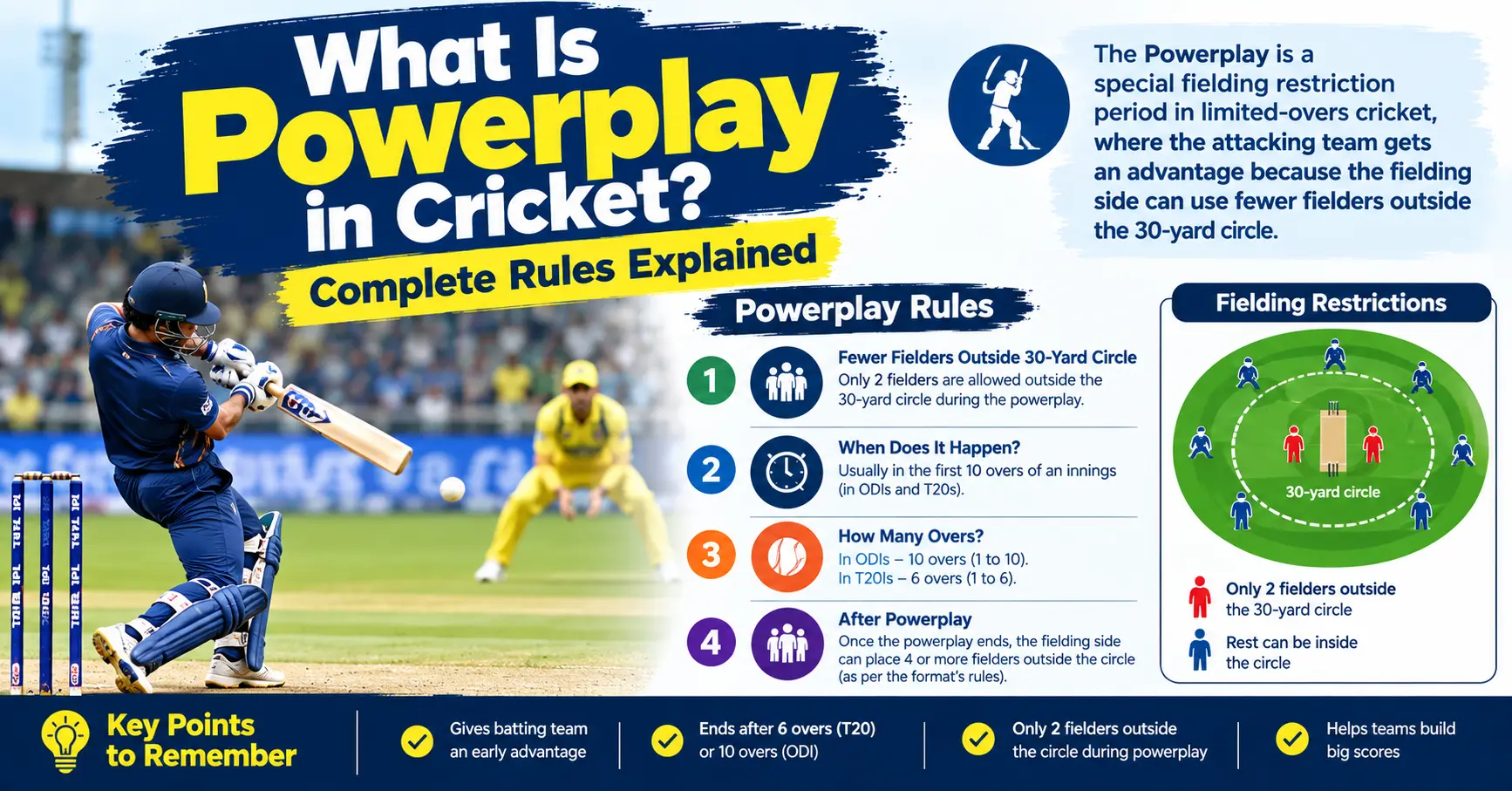
Powerplay in cricket is a set of overs in limited-overs cricket during which the fielding team can only place a restricted number of players outside the 30-yard circle. This rule exists to help the batting side score faster early in an innings. Powerplay applies in ODIs and T20s. It does not apply in Test cricket at all.
Introduction
If you’ve ever watched the start of an ODI or T20 innings and noticed the outfield looking strangely empty, that’s the powerplay at work. It’s one of the first terms every new cricket fan needs to understand, and once it clicks, entire innings start making a lot more sense.
This guide breaks down exactly what powerplay is in cricket, the specific rules for each format, how it came to exist, and why it shapes nearly every limited-overs match played today.
What Does Powerplay Actually Mean?
A powerplay is a phase of fielding restrictions. During these overs, the fielding captain cannot place fielders wherever they want. Only a limited number of players can stand outside the 30-yard circle, an imaginary boundary marked around the pitch.
Fewer fielders on the boundary means more gaps for the batting side to hit through. That’s the entire point. Powerplay rules exist to reward attacking batting and create more entertaining cricket in the shorter formats of the game.
Powerplay Rules in T20 Cricket
T20 keeps this simple. Under current ICC men’s T20I playing conditions, there is only one powerplay period per innings.
Overs 1 to 6: Only 2 fielders are allowed outside the 30-yard circle.
Overs 7 to 20: Up to 5 fielders can be placed outside the circle.
That’s the entire structure. Unlike ODIs, T20 does not split the powerplay into multiple phases, and the batting team has no say in when it happens. It always covers the first six overs, automatically, in every T20 international and in most domestic T20 leagues, including the IPL.
Powerplay Rules in ODI Cricket
ODI cricket uses a more layered system, split across three separate phases:
| Overs | Maximum Fielders Outside the Circle |
|---|---|
| 1 to 10 (Powerplay 1) | 2 |
| 11 to 40 (Powerplay 2) | 4 |
| 41 to 50 (Powerplay 3) | 5 |
The first ten overs carry the tightest restrictions, giving opening batters the best chance to score freely against a new ball. The middle overs, from 11 to 40, ease that restriction slightly. The final ten overs open the field up the most, since bowling sides need more fielders on the boundary to defend against the aggressive hitting that typically happens at the death of an innings.
It’s worth noting that ODI powerplay rules have changed more than once over the years. Between 2005 and 2015, teams could actually choose a five-over “batting powerplay” at a time of their choosing during the middle overs. That flexible system was scrapped in 2015 in favor of the fixed three-phase structure used today.
Does Powerplay Apply in Test Cricket?
No. Powerplay in cricket rules do not exist in Test cricket at all. Since Test matches are built around patience, defense, and long-form strategy rather than quick scoring, fielding restrictions of this kind were never introduced to the format.
The General Fielding Rule That Still Applies
Even outside powerplay overs, one fielding restriction always applies in every format: no more than 5 fielders are allowed on the leg side of the pitch at the moment the ball is delivered. This rule exists independently of powerplay restrictions and is a common source of confusion for newer fans, since it’s easy to mix up with the circle-based powerplay rules.
What Happens If a Team Breaks the Powerplay Rule?
If the fielding side has too many fielders outside the circle at the instant the ball is bowled, the umpire calls a no-ball. In ODIs and T20s, a no-ball also earns the batting side a free hit on the very next delivery, making powerplay violations a costly mistake for the fielding captain. Close powerplay dismissals, especially caught-behind or LBW appeals during this aggressive phase, are also among the most common decisions sent to the DRS for review.
How Powerplay in cricket Rules Have Evolved
Fielding restrictions weren’t always part of the game. Here’s a quick timeline of how the modern powerplay system came to be:
1983: Basic fielding restrictions were introduced for the first time to make ODI cricket more entertaining for spectators.
1992: A formal 15-over restriction period was implemented at the start of ODI innings.
2005: The ICC split powerplay into separate blocks, introducing the flexible “batting powerplay” that captains could call at their own discretion.
2015: The current fixed three-phase ODI structure was introduced, removing the option for teams to choose when their powerplay overs occurred.
T20 cricket, by comparison, has kept its powerplay rules largely unchanged since the format’s introduction, sticking with a simple, fixed six-over restriction from the very start.
Why powerplay in cricket Matters So Much Strategically
powerplay in cricket overs often decide the entire rhythm of a limited-overs innings. In T20 cricket specifically, teams frequently aim to score 40 to 60 runs inside the first six overs, since a fast start sets up everything that follows in the middle and death overs.
For the fielding side, powerplay overs are just as tactically important. Bowling sides often use their sharpest new-ball bowlers during this phase, hoping to take early wickets while fielding restrictions make containing runs difficult. Fast, full deliveries aimed at the stumps also make this the phase where LBW appeals are most common, since batters are often driving early and misjudging length. A team that loses early wickets during powerplay, even while scoring quickly, can end up in serious trouble later in the innings.
Frequently Asked Questions
What is powerplay in cricket?
Powerplay is a phase in limited-overs cricket, used in ODIs and T20s, where the fielding team can only place a limited number of players outside the 30-yard circle, making it easier for the batting side to score.
How many overs is the powerplay in T20 cricket?
The powerplay in T20 cricket covers the first 6 overs of each innings, during which only 2 fielders are allowed outside the 30-yard circle.
How many powerplay phases are there in an ODI?
Three. Powerplay 1 covers overs 1 to 10, Powerplay 2 covers overs 11 to 40, and Powerplay 3 covers overs 41 to 50, each with a different fielder limit outside the circle.
Is there a powerplay in Test cricket?
No. Powerplay rules only apply in ODI and T20 cricket. Test cricket has no fielding restrictions of this kind.
What happens if a team breaks powerplay fielding rules?
The umpire calls a no-ball, and in ODIs and T20s, the batting side also receives a free hit on the next delivery.
Can the batting team choose when their powerplay happens?
Not anymore. Between 2005 and 2015, ODI teams could choose a flexible batting powerplay during the middle overs, but that option was removed in 2015 in favor of the current fixed three-phase system.
How big is the 30-yard circle used for powerplay?
The circle has a radius of roughly 27.43 meters, or 30 yards, measured from the center of the pitch at each end.
Conclusion
Powerplay looks like a small technical rule from the outside, just a limit on where fielders can stand. In practice, it shapes almost everything about how a limited-overs innings unfolds, from an opener’s decision to attack early to a captain’s choice of which bowler to trust with the new ball. Reading these overs well is often what separates good captains from great ones, a skill you’ll notice repeatedly if you look at the world’s best cricket captains and how they manage the powerplay phase specifically. Once you know exactly how many fielders are allowed where, and when, the sport’s most exciting overs start making a lot more sense.
