
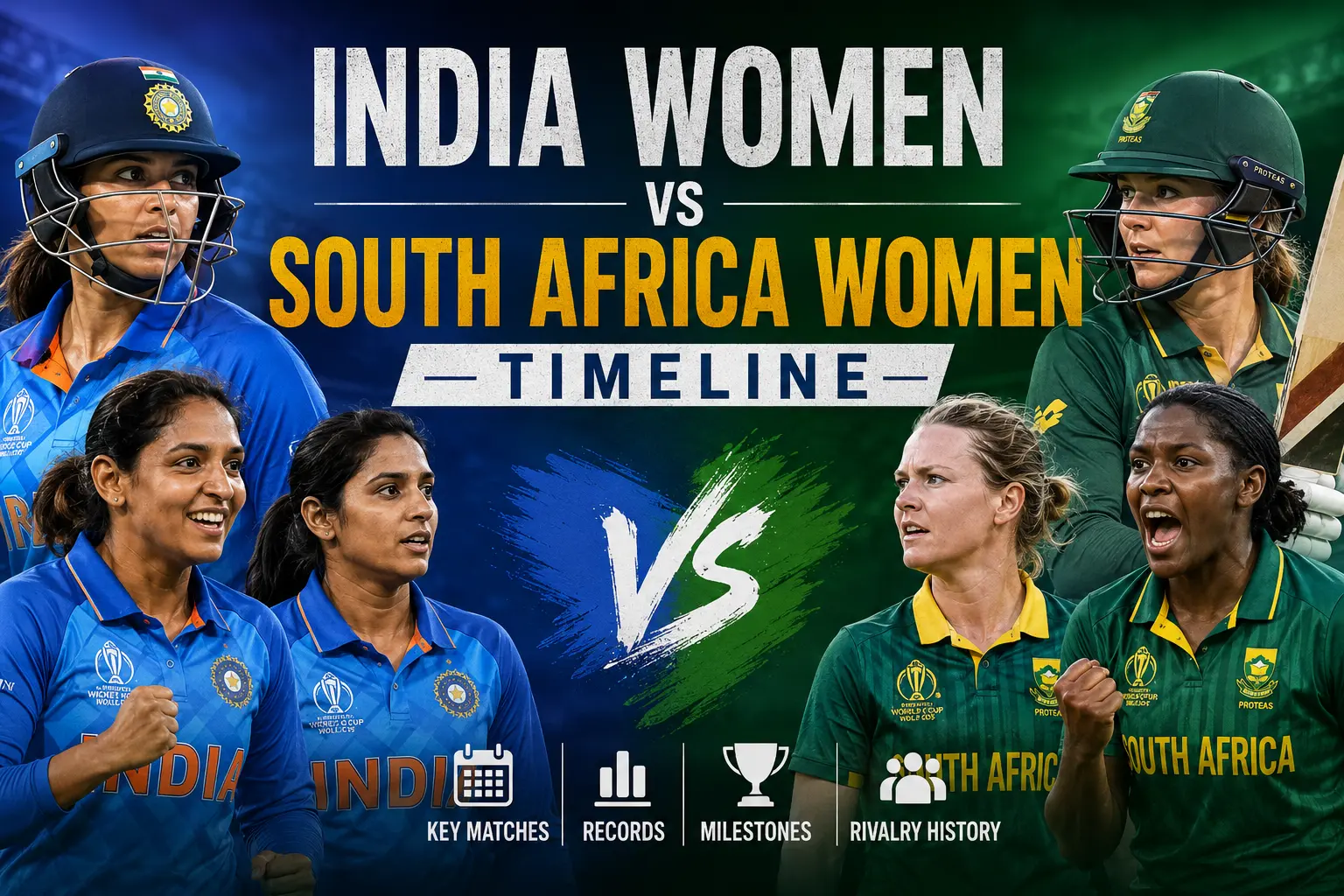
Women’s cricket has grown tremendously over the last two decades, and few rivalries reflect that growth better than the India Women vs South Africa Women contest. What started as an occasional bilateral matchup in the late 1990s has evolved into a highly competitive rivalry across ODIs, T20Is, and Test cricket.
The India Women’s National Cricket Team vs South Africa Women’s National Cricket Team timeline is not just about wins and losses. It tells the story of two cricketing nations that developed their women’s programs differently but eventually reached a point where every series became unpredictable.
Today, matches between India Women vs South Africa Women attract global attention because both teams possess world-class batters, match-winning all-rounders, quality pace attacks, and experienced spin departments.
In this detailed timeline, we’ll explore the rivalry’s history, major turning points, head-to-head records, iconic performances, and what makes this contest one of the most exciting rivalries in modern women’s cricket.
Table of Contents
ToggleQuick Overview: India Women vs South Africa Women Rivalry
| Format | Matches Played* | India Wins | South Africa Wins | Draw/Tie/NR |
|---|---|---|---|---|
| ODIs | 30+ | India Lead | SA Trail | Few NR |
| T20Is | 25+ | Closely Matched | Closely Matched | Few NR |
| Tests | Limited Meetings | Both Teams Have Wins | Both Teams Have Wins | Draws |
*Records may vary slightly depending on the latest fixtures.
Why This Rivalry Matters
Unlike many international rivalries where one team dominates completely, India and South Africa have produced competitive contests in different formats.
- India traditionally excelled in spin-friendly conditions.
- South Africa developed one of the strongest pace attacks in women’s cricket.
- Both nations have consistently ranked among the world’s top teams.
- ICC tournaments have added extra significance to the rivalry.
This balance of strengths makes every series fascinating.
Did You Know – India Women vs Pakistan Women Head-to-Head in T20I, ODI & Test Records
India Women vs South Africa Women Timeline: Year-by-Year Evolution
1997: The Rivalry Begins
The first official ODI meeting between India Women and South Africa Women took place in 1997.
At that stage, women’s cricket lacked the infrastructure and visibility it enjoys today. International fixtures were less frequent, and professional support systems were limited.
India entered the rivalry with a more established setup and generally held the upper hand during the early encounters.
Why It Was Important
- Marked the beginning of official competition.
- Introduced two emerging women’s cricket nations to each other.
- Created the foundation for future bilateral contests.
2000–2005: Building Competitive Foundations
During the early 2000s, meetings between the teams remained relatively infrequent.
India relied heavily on:
- Disciplined batting
- Spin bowling
- Tactical cricket
South Africa focused on:
- Athletic fielding
- Fast bowling development
- Improving international competitiveness
Although India won more matches, South Africa gradually became tougher opponents.
Major Development
The rivalry began moving beyond one-sided contests and developed genuine competitiveness.
2002: First Women’s Test Match
One of the biggest milestones arrived in 2002, when the teams faced each other in Women’s Test cricket.
Women’s Tests are rare, making every match historically significant.
The longer format tested:
- Patience
- Technique
- Bowling endurance
- Mental strength
Unlike limited-overs cricket, Test matches revealed deeper strengths and weaknesses.
Significance
The introduction of Test cricket elevated the rivalry and showed both teams were capable of competing across all formats.
2006–2013: Bilateral Series Strengthen the Rivalry
This period transformed India vs South Africa from an occasional matchup into a genuine international rivalry.
Regular tours allowed teams to:
- Understand each other’s tactics
- Adapt to foreign conditions
- Develop long-term strategies
India’s Strengths
India’s spin-heavy attack frequently dominated on subcontinent pitches.
Key advantages included:
- Better control in middle overs
- Experienced batters
- Strong home performances
South Africa’s Growth
South Africa continued improving through:
- Pace bowling resources
- Fitness standards
- Fielding excellence
Although India still enjoyed better results overall, South Africa increasingly challenged them.
Rise of Modern Stars
The late 2000s and early 2010s saw several players become central figures in the rivalry.
For India:
- Mithali Raj
- Jhulan Goswami
- Harmanpreet Kaur
For South Africa:
- Dane van Niekerk
- Marizanne Kapp
- Mignon du Preez
These players helped transform ordinary bilateral matches into high-quality international contests.
2014–2019: The T20 Revolution
The rise of T20 cricket completely changed the nature of the rivalry.
Shorter formats rewarded:
- Power hitting
- Athletic fielding
- Aggressive captaincy
South Africa adapted extremely well.
Why T20s Changed Everything
In ODIs, India often controlled games through spin and accumulation.
In T20s:
- Momentum shifted quickly.
- South Africa’s power hitters became more dangerous.
- Fast bowlers gained greater influence.
The gap between the teams narrowed significantly.
Many cricket fans were surprised to see how competitive South Africa became in T20 cricket.
Also Read – India Women’s National Cricket Team vs England Women’s National Cricket Team Timeline
2017 Women’s Cricket World Cup: A Defining Moment
The 2017 ICC Women’s Cricket World Cup became a landmark event for women’s cricket globally.
India’s remarkable run to the final brought unprecedented attention to the women’s game.
Although India and South Africa were competing on the same world stage, the tournament changed perceptions.
Impact on the Rivalry
- Higher media coverage.
- Greater fan interest.
- Increased pressure in future ICC meetings.
From this point onward, every India-South Africa encounter carried greater significance.
2020–2023: South Africa Challenges India’s Dominance
This period marked perhaps the biggest shift in the rivalry.
South Africa no longer entered series as underdogs.
Instead, they arrived believing they could win anywhere.
The 2021 ODI Series in India
One of the most important moments came when South Africa won a major ODI series in India.
Historically, Indian conditions favored:
- Spin bowlers
- Home batters
- Familiar conditions
South Africa’s success proved they could overcome those challenges.
Why This Was a Turning Point
It broke the perception that India were unbeatable at home against South Africa.
The rivalry became more balanced than ever before.
Emerging New Superstars
The early 2020s introduced a new generation of match-winners.
India
- Smriti Mandhana
- Shafali Verma
- Deepti Sharma
- Jemimah Rodrigues
South Africa
- Laura Wolvaardt
- Marizanne Kapp
- Tazmin Brits
- Nadine de Klerk
These players added fresh energy and modern tactical approaches.
2024: Renewed Interest in Test Cricket
A major highlight of the rivalry came through another Women’s Test encounter.
Women’s Test cricket remains rare, making every fixture valuable.
The match showcased:
- Long batting partnerships
- Strategic bowling spells
- Tactical captaincy
Why It Mattered
It demonstrated how far both teams had progressed.
Neither side relied solely on white-ball specialists anymore.
Both possessed players capable of succeeding in the longest format.
Tactical Comparison: India vs South Africa
Understanding the rivalry requires looking beyond statistics.
India’s Traditional Formula
India usually succeed through:
Strong Top Order
Batters often provide stable starts that set up innings.
Spin Dominance
Indian spinners regularly control the middle overs and restrict scoring.
Tournament Experience
India have played numerous high-pressure ICC matches.
South Africa’s Winning Formula
South Africa often rely on:
Fast Bowling
Their pace attack remains one of the strongest in women’s cricket.
Athletic Fielding
Few teams save as many runs through fielding excellence.
Powerful Finishers
South Africa’s lower-middle order frequently changes games in the final overs.
Key Players Who Defined the Rivalry
India’s Most Influential Performers
Mithali Raj
The legendary batter was the backbone of India’s batting lineup for years.
Smriti Mandhana
One of the most elegant openers in women’s cricket.
Deepti Sharma
A complete all-rounder who contributes in every format.
Jhulan Goswami
India’s pace-bowling icon and one of the greatest fast bowlers in women’s cricket history.
South Africa’s Most Influential Performers
Laura Wolvaardt
Consistent, technically sound, and reliable.
Marizanne Kapp
Arguably South Africa’s greatest all-round cricketer.
Shabnim Ismail
One of the fastest bowlers women’s cricket has ever produced.
Nadine de Klerk
A modern all-rounder capable of changing matches with both bat and ball.
What Usually Decides India Women vs South Africa Women Matches?
1. Powerplay Performance
Early wickets often determine the direction of the match.
2. Middle-Overs Battle
India’s spinners versus South Africa’s batters frequently becomes the defining phase.
3. Death Overs Execution
Close matches are often decided during the final 10 overs.
4. Pressure Handling
ICC tournaments have shown that handling pressure is often more important than raw talent.
Also Read – ICC Women’s T20 World Cup 2026 Full Schedule, Date, Time and Venue
How the Rivalry Has Changed Over Time
Early Era (1997–2005)
India clearly stronger.
Development Era (2006–2013)
South Africa become increasingly competitive.
T20 Era (2014–2019)
Gap narrows significantly.
Modern Era (2020–Present)
Rivalry reaches near parity.
This evolution is what makes the timeline so fascinating.
Future of the Rivalry
Looking ahead, the India Women vs South Africa Women rivalry appears stronger than ever.
Several factors support this growth:
- Better domestic leagues.
- Increased professional contracts.
- Rising television audiences.
- Improved grassroots development.
- Expansion of women’s ICC tournaments.
With both teams regularly challenging the world’s best sides, future encounters are likely to become even more competitive.
Conclusion
The India Women vs South Africa Women timeline reflects far more than cricket statistics. It mirrors the rise of women’s cricket itself.
India may have enjoyed greater success during the early years, but South Africa’s remarkable growth has transformed the rivalry into one of the most balanced contests in international women’s cricket.
From their first ODI meeting in 1997 to modern-day battles across ODIs, T20Is, and Tests, both teams have contributed memorable moments, legendary performances, and dramatic finishes.
Today, there is no guaranteed winner when these sides meet. That uncertainty is exactly what makes this rivalry special and why fans around the world eagerly anticipate every new chapter.
Frequently Asked Questions (FAQs)
Q1. When did India Women first play South Africa Women?
India Women and South Africa Women played their first official ODI match in 1997, marking the beginning of the rivalry.
Q2. Which team has a better overall record?
India have historically enjoyed more success, particularly in ODI cricket, although South Africa have significantly reduced the gap in recent years.
Q3. Have India Women vs South Africa Women played Test cricket?
Yes. The teams have faced each other in Women’s Test matches, making the rivalry competitive across all major formats.
Q4. Who are the biggest stars in this rivalry?
Key names include Mithali Raj, Smriti Mandhana, Deepti Sharma, Jhulan Goswami, Laura Wolvaardt, Marizanne Kapp, Shabnim Ismail, and Nadine de Klerk.
Q5. Why is the India Women vs South Africa Women rivalry important?
Because it showcases two of the strongest women’s cricket teams in the world and highlights the remarkable growth of women’s cricket over the last three decades.
Q6. What is the biggest strength of India Women?
India’s biggest strengths are batting depth, quality spin bowling, and experience in major ICC tournaments.
Q7. What is South Africa Women’s biggest advantage?
South Africa possess a powerful pace attack, excellent fielding standards, and aggressive lower-order batting that can change games quickly.