
Cricket dekhte waqt aapne pitch par bahut si white lines dekhi hongi — kabhi batsman inhi lines ke around out ho jata hai, kabhi bowler ka pair inhi lines ko cross karne se “No Ball” ho jata hai. Yeh sab lines hi asal mein crease kehlati hain, क्रिकेट में 4 क्रीज कौन सी हैं aur inhi ka poora system samajhna cricket ke rules samajhne ke liye bahut zaroori hai.
Is article mein hum detail mein samjhenge ki क्रिकेट में 4 क्रीज कौन सी हैं, unki exact measurements kya hain, aur har ek crease ka game mein kya role hai.
क्रिकेट में 4 क्रीज Kaun Si Hain? (Quick Answer)
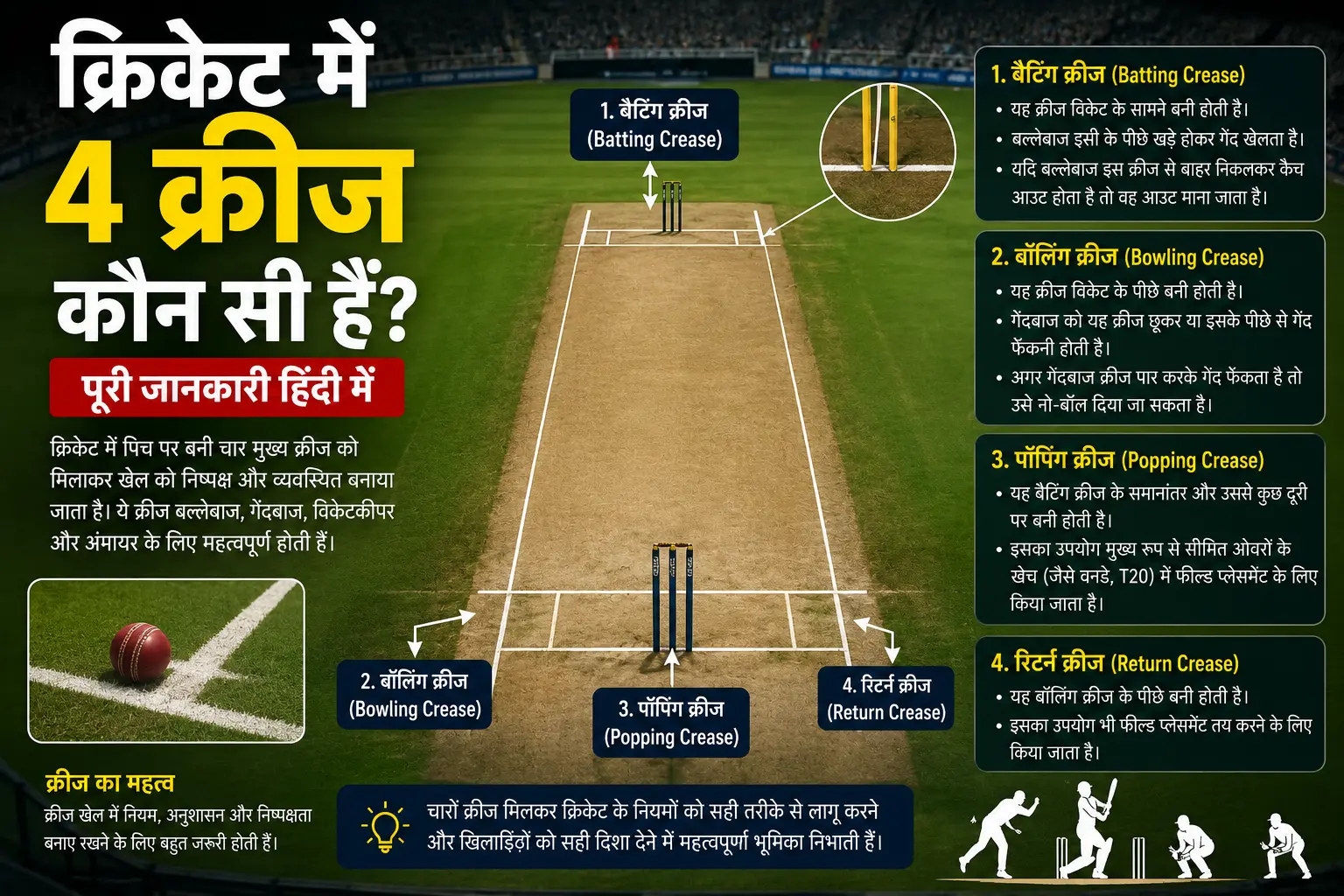
ICC ke official Laws of Cricket (Law 9) ke mutabik, pitch ke har ek end par yeh 4 crease lines marked hoti hain:
- Bowling Crease (1)
- Popping Crease (1)
- Return Crease (2 — ek dono taraf, left aur right)
Matlab technically 3 alag type ki creases hoti hain, lekin Return Crease do baar (stumps ke dono side) draw hoti hai, isliye total 4 crease lines ban jaati hain har end par. Aur chunki pitch ke dono ends par yeh same pattern repeat hota hai (batting end aur bowling end), poori pitch par total 8 crease lines hoti hain.
Chaliye ab har ek crease ko detail mein samajhte hain.
1. Bowling Crease
Bowling Crease wo line hoti hai jo stumps ke exact center se hoke guzarti hai — yani teeno stumps isi line par khade hote hain.
Bowling Crease Ki Measurements
- Length: 8 feet 8 inches (2.64 meters)
- Position: Stumps iske exact center mein hote hain
- Yeh line pitch ke dono ends ko define karti hai, aur dono bowling creases ke beech ki distance 22 yards (66 feet ya 20.12 meters) hoti hai — yehi cricket pitch ki official length hai
Bowling Crease Ka Kaam Kya Hai?
- Yeh define karti hai ki pitch kaha khatam hoti hai
- Agar wicket-keeper apni position se aage (bowling crease se aage) move kar jata hai bowler ke ball dalne se pehle, to yeh bhi ek violation ban sakta hai
- Historically, bowler ka back foot is line ke peeche rehna zaroori tha, lekin ab yeh rule change ho chuka hai (aage detail mein samjhenge)
2. Popping Crease (Sabse Important Crease)
Popping Crease cricket ki sabse zyada discuss hone wali crease hai, kyunki batsman ke out hone (run out, stumped) aur bowler ke no-ball dono decisions isi crease se related hote hain.
Popping Crease Ki Measurements
- Yeh Bowling Crease se 4 feet (1.22 meters) aage hoti hai, aur usi ke parallel hoti hai
- Iski length kam se kam 6 feet (1.83 meters) stumps ki center line se dono taraf hoti hai
- Officially iski length “unlimited” maani jaati hai — yani theoretically yeh line poori width tak extend ho sakti hai
Popping Crease Batsman Ke Liye Kya Karti Hai?
Run Out: Agar batsman running karte waqt apna bat ya body ka koi hissa popping crease ke peeche ground par nahi rakh pata jab stumps break hote hain, to woh run out ho jata hai.
Stumped: Agar striker batsman shot khelne ke liye popping crease se aage nikal jata hai, aur wicket-keeper bails gira deta hai bina koi run attempt ke, to batsman stumped out ho sakta hai.
Popping Crease Bowler Ke Liye Kya Karti Hai?
Bowler ke liye yeh crease “Front Foot No-Ball” rule se directly connected hai. Modern cricket rules ke mutabik:
- Bowler ke front foot ka kam se kam kuch hissa delivery ke waqt popping crease ke peeche (yani crease ko touch ya usse peeche) hona chahiye
- Agar bowler ka poora front foot popping crease se aage chala jata hai, to umpire “No Ball” call karta hai
Yehi wo crease hai jiske around aapne kai baar controversial No Ball decisions dekhe honge, especially close matches mein.
3. Return Crease (Do Lines)
Return Crease ek nahi, balki do lines hoti hain — stumps ke dono taraf ek-ek, aur yeh Bowling Crease se right angle (90 degree) par hoti hain.
Return Crease Ki Measurements
- Yeh stumps ki center line se 4 feet 4 inches (1.32 meters) ki distance par, dono taraf marked hoti hai
- Popping Crease se yeh line kam se kam 8 feet (2.44 meters) peeche tak extend hoti hai
- Yeh Bowling Crease ke saath connect hoke ek “box” jaisa shape banati hai, jispar bowler apna delivery stride leta hai
Return Crease Ka Kaam Kya Hai?
Yeh crease bhi bowler ke liye No Ball decide karne mein use hoti hai — lekin side-wise (width) violation ke liye:
- Bowler ke back foot ka kuch hissa delivery stride ke dauran return crease ke andar hona chahiye
- Agar bowler ka back foot in dono lines ke bahar (outside) chala jata hai, to yeh bhi No Ball maana jata hai
Test aur First-Class cricket mein Return Crease Wide Ball decide karne mein bhi indicator ka kaam karti hai, jabki ODI aur T20 cricket mein iske liye ek alag “Wide Guideline” (blue line) use hoti hai.
Quick Reference Table: Sab 4 Creases Ek Nazar Mein
| Crease | Length/Distance | Kaam |
|---|---|---|
| Bowling Crease | 8 ft 8 in (stumps center mein) | Pitch ke end ko define karti hai |
| Popping Crease | Bowling crease se 4 ft aage | Run out, Stumped, Front-foot No Ball |
| Return Crease (x2) | Center se 4 ft 4 in dono taraf | Back-foot No Ball, Wide ball indicator |
Historical Background: Creases Kaise Aayi?
Interesting baat yeh hai ki creases ka concept 18th century se hi cricket mein exist karta hai. Shuru mein yeh lines scratch marks se banayi jaati thi — zameen par ek inch deep aur ek inch wide cuts lagakar. Baad mein, 1870s ke around, cricketer Alfred Shaw ne suggestion diya ki inhe whitewash (white paint) se mark kiya jaye, jo dheere-dheere standard practice ban gayi aur aaj tak wahi tarika use hota hai.
“Popping Crease” naam bhi interesting hai — yeh purane zamane ke “popping hole” concept se aaya hai, jab batsman ko apna bat ek specific hole mein “pop” (dalna) karna hota tha bachne ke liye.
Kyun Yeh 4 Creases Itni Important Hain?
Cricket ek aisा khel hai jaha millimeter-level precision bhi match ka result badal sakta hai — chahe woh ek close run-out ho ya ek marginal No Ball. Yeh 4 creases hi wo fair-play ka framework provide karti hain jisse:
- Batsman ko pata rehta hai kaha tak safe hai
- Bowler ko clear boundary milti hai delivery ke liye
- Umpire ko decisions lene ke liye ek consistent, measurable standard milta hai
- Fielding side (especially wicket-keeper) ko bhi apni position ka pata rehta hai
Bina in creases ke, cricket mein bahut saare decisions purely subjective ho jate, jo game ki fairness ko kharab kar deta.
Frequently Asked Questions
Q: Cricket mein kitni creases hoti hain ek end par?
A: Har end par 3 type ki creases hoti hain — 1 Bowling Crease, 1 Popping Crease, aur 2 Return Creases — jo total milakar 4 crease lines banati hain.
Q: Popping Crease Bowling Crease se kitni door hoti hai?
A: Popping Crease, Bowling Crease se 4 feet (1.22 meters) aage hoti hai, aur uske parallel hoti hai.
Q: Return Crease ka use kya hai?
A: Return Crease bowler ke back-foot No Ball decide karne mein use hoti hai — agar bowler ka back foot in lines ke bahar chala jaye, to No Ball call hoti hai. Yeh Wide Ball decide karne mein bhi indicator ka kaam karti hai.
Q: Kya batsman Popping Crease ke bahar out ho sakta hai?
A: Haan — agar batsman ka bat ya body Popping Crease ke peeche ground par nahi hai jab stumps break hote hain (running ke dauran ya stumping attempt mein), to woh out ho sakta hai.
Q: Dono Popping Creases (dono ends) ke beech ki distance kitni hoti hai?
A: Dono Popping Creases ke beech ki distance 58 feet (18 meters) hoti hai, jabki dono Bowling Creases (jo pitch ki official length define karti hain) ke beech 22 yards (66 feet) ki distance hoti hai.
Related Reads
- DRS Rule in Cricket Explained: How It Works
- How Many Creases Are There in Cricket? A Complete Detailed Guide
- What Is LBW in Cricket? Complete Rule Explained
Conclusion
Cricket ki yeh 4 creases — Bowling, Popping, aur do Return Creases — sirf zameen par khichi hui lines nahi hain, balki poore khel ki fairness aur structure inhi par depend karti hai. Agli baar jab aap match dekhein aur koi close run-out ya No Ball decision aaye, ab aap exactly samajh payenge ki umpire kis specific line ke basis par decision le raha hai. Yeh basic lekin fundamental knowledge hai jo har cricket fan ke paas honi chahiye.