
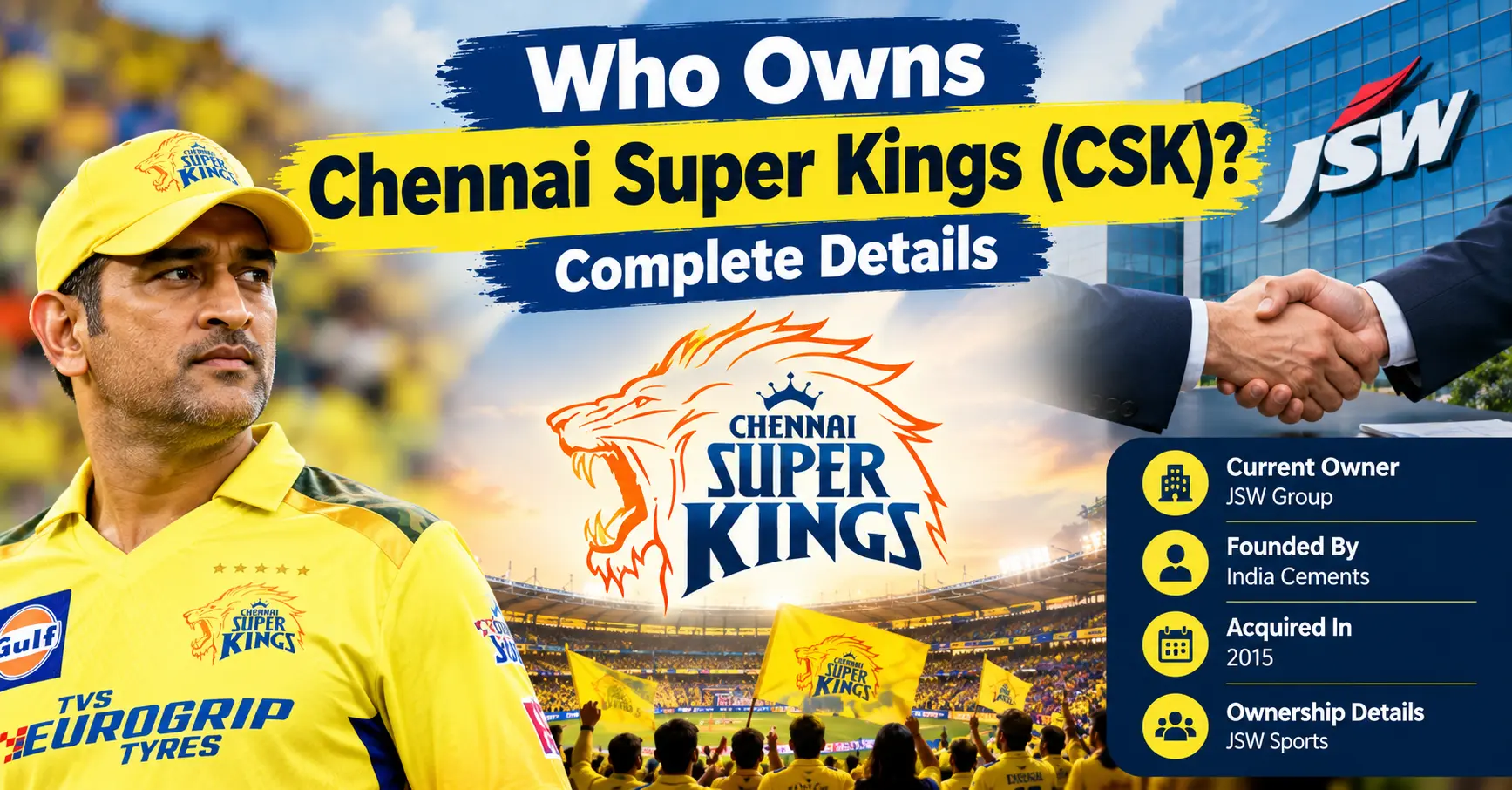
Chennai Super Kings (CSK) is owned by Chennai Super Kings Cricket Limited (CSKCL), a public unlisted company. N. Srinivasan, the former BCCI President and longtime head of India Cements, serves as CSKCL’s Chairman and is the franchise’s principal promoter. MS Dhoni is CSK’s most famous face and captain, but he does not own the team.
Introduction
Ask any cricket fan who owns Chennai Super Kings, and most will say MS Dhoni without a second thought. It’s an understandable guess. Dhoni has been the face of this franchise since its very first season in 2008. But the real answer to who owns Chennai Super Kings sits in a different place entirely, inside a corporate structure that makes CSK genuinely unique among all ten IPL teams, including franchises like Punjab Kings, which follows a completely different ownership model.
This guide breaks down exactly who owns CSK, how that ownership is structured, what happened during the franchise’s two-year ban, and why CSK operates unlike almost any other team in the league.
Who Owns Chennai Super Kings? The Legal Answer
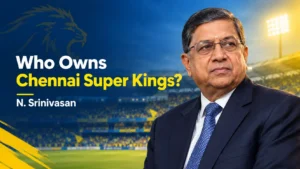
The legal owner of Chennai Super Kings is Chennai Super Kings Cricket Limited, commonly shortened to CSKCL. This is a public limited company, though its shares are not listed on a formal stock exchange like the NSE or BSE.
N. Srinivasan sits at the center of that company as Chairman. He’s the former President of the BCCI and the longtime Managing Director of India Cements, the business that originally brought CSK into existence when the IPL launched in 2008. Srinivasan’s family, through the promoter group tied to India Cements, holds the controlling stake in CSKCL, even though the company technically counts roughly 100,000 shareholders.
How CSK’s Ownership Structure Actually Works
CSK’s ownership setup is genuinely unusual for a major sports franchise, and it’s worth breaking down clearly.
In 2008, India Cements bought the Chennai franchise outright for $91 million, making it the fourth most expensive team sold at the IPL’s launch. For years, the team functioned as a direct extension of India Cements’ business.
That changed in 2015. To comply with BCCI conflict-of-interest rules, the cricket team was demerged from India Cements into its own separate company, Chennai Super Kings Cricket Limited. On October 9, 2015, CSKCL shares were distributed to existing India Cements shareholders on a 1:1 basis. That single decision is what makes CSK’s ownership structure so different from every other franchise in the league.
As of March 2024, the promoter group linked to N. Srinivasan held about 41.65% of CSKCL’s equity. The remaining 58.35% is spread across public shareholders, including institutional investors like LIC. In practical terms, that means thousands of ordinary shareholders technically own a piece of CSK, even though day-to-day control sits firmly with the Srinivasan family.
Compare that to teams like Mumbai Indians, wholly owned by Reliance Industries, or Kolkata Knight Riders, owned by a private consortium including Shah Rukh Khan. CSK is the only major IPL franchise structured this way, closer to a public corporation than a private ownership group.
The 2026 Leadership Update
CSK’s corporate structure went through a significant shake-up recently. In December 2024, India Cements sold its entire cement business to UltraTech Cement. That deal temporarily removed the Srinivasan family from CSKCL’s board altogether, since their historic power base, India Cements itself, no longer existed in its original form.
The family returned to the board in February 2025, when N. Srinivasan and his daughter, Rupa Gurunath, both joined CSKCL’s board. According to the company’s 2025 annual report, Srinivasan formally succeeded his cousin, R. Srinivasan, as Chairman in May 2025. Ahead of the IPL 2026 season, Rupa Gurunath was also appointed as a Whole Time Director, further cementing family control over the franchise even after India Cements itself exited the picture entirely.
Is MS Dhoni an Owner of CSK?
No. Despite being the single most recognizable figure associated with the franchise, MS Dhoni does not hold an ownership stake in Chennai Super Kings. He is the team’s captain and, functionally, its most valuable brand asset, but legal ownership and control rest with CSKCL and the Srinivasan family.
The CSK Ban: What Actually Happened
Any complete answer to “who owns CSK” has to include the franchise’s most turbulent chapter. In 2013, Gurunath Meiyappan, CSK’s Team Principal and N. Srinivasan’s son-in-law, was arrested by Mumbai Police just before that year’s IPL final between CSK and Mumbai Indians. He was found guilty of betting on IPL matches and passing inside information to bookmakers, a serious breach of the league’s anti-corruption code, though notably not of match-fixing itself.
The Supreme Court of India appointed the Justice Lodha Committee in 2015 to investigate. The committee’s ruling was severe: both Chennai Super Kings and Rajasthan Royals were suspended from the IPL entirely for two years, covering the 2016 and 2017 seasons. Meiyappan received a lifetime ban from all BCCI-organized cricket. No CSK players or coaching staff were implicated in the scandal.
CSK returned in 2018 and immediately won that year’s IPL title, a comeback still remembered as one of the most emotional storylines in the league’s history.
CSK’s Value and Business Growth
Under Srinivasan family control, CSK has grown into one of the most valuable properties in Indian sport. The franchise’s brand value has been estimated at around $235 million, built on five IPL titles and twelve playoff appearances across fifteen seasons, a level of consistency very few sports franchises anywhere in the world can match. CSK has also expanded its business beyond the IPL itself, with connected franchises competing in overseas T20 leagues in South Africa and the United States.
Frequently Asked Questions
Who is the current owner of Chennai Super Kings?
Chennai Super Kings Cricket Limited (CSKCL) legally owns the franchise, which answers the core question of who owns Chennai Super Kings today. N. Srinivasan serves as its Chairman and is the principal figure behind the team’s ownership.
Does MS Dhoni own Chennai Super Kings?
No. Dhoni is CSK’s captain and the franchise’s most recognizable player, but he holds no ownership stake in the team.
What company originally owned CSK?
India Cements Limited originally acquired and owned the CSK franchise in 2008, before the team was demerged into its own separate company, CSKCL, in 2015.
Why was CSK banned from the IPL?
CSK was suspended for the 2016 and 2017 seasons after the Justice Lodha Committee found team official Gurunath Meiyappan guilty of betting on IPL matches, a violation of the league’s anti-corruption rules.
Can ordinary people buy shares in CSK?
Yes, in a limited sense. CSKCL is a public unlisted company with roughly 100,000 shareholders, and its shares can be traded in the unlisted/grey market, though controlling interest remains with the Srinivasan family.
Who is Rupa Gurunath, and what is her role at CSK?
Rupa Gurunath is N. Srinivasan’s daughter. She joined the CSKCL board in February 2025 and was appointed a Whole Time Director ahead of the 2026 IPL season.
How much did India Cements pay for CSK in 2008?
India Cements acquired the Chennai franchise for $91 million when the IPL launched in 2008, making it the fourth most expensive team sold at the time.
Conclusion
So, who owns Chennai Super Kings? On the surface, the franchise looks like it’s built entirely around MS Dhoni. Legally, though, it belongs to Chennai Super Kings Cricket Limited, a public unlisted company under the firm control of N. Srinivasan and his family. That structure has survived a corporate demerger, a two-year league ban, and the sale of its founding parent company, and still come out the other side as one of the most valuable and successful franchises in IPL history.