

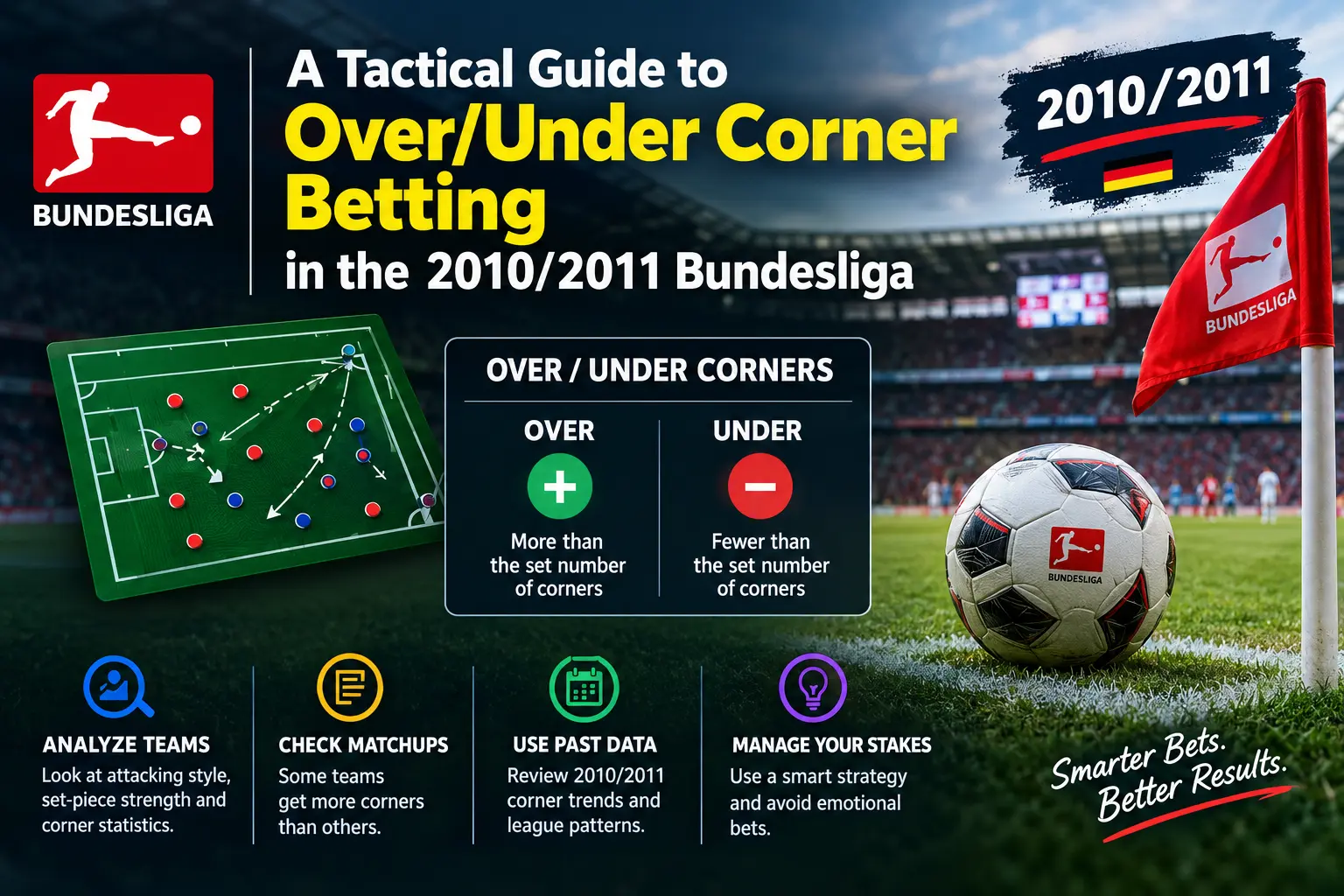
Wagering on corner kicks represents one of the most mechanically objective sectors in sports betting, yet recreational participants routinely treat corner totals as a random byproduct of general match excitement. In reality, corner events do not correlate cleanly with total goals scored; rather, they are the direct mathematical consequence of spatial geometry, attacking channel preferences, and the specific defensive containment strategies deployed by opposing coaches. The 2010/2011 German Bundesliga season offers a classic blueprint for corner analysis, as distinct tactical identities created extreme statistical divergence across the league. Identifying how wing-heavy positional attacks generate endless deflections while hyper-central transition setups suppress corner counts allows disciplined bettors to price corner lines with far greater precision than standard bookmaker algorithms.
The Tactical Geometry of Corner Kick Production
Corner kicks occur when an attacking unit consistently delivers the ball into wide final-third zones against a defensive block that prioritizes guarding the central box over contesting the flanks. When an offensive system relies on overlapping fullbacks and isolated wingers attempting crosses from near the byline, low-block defenders routinely deflect these attempts over the endline to avoid conceding open-play tap-ins. Conversely, teams that build their attacks through intricate central combination play rarely win corner kicks because central defenders tackle forward or force backward passes, keeping the ball in play within the middle third.
Understanding this dynamic requires evaluating team attacking width rather than baseline offensive quality. A world-class attacking side that funnels possession through rapid central one-twos often produces far fewer corner kicks than an uninspired mid-table club that mindlessly pumps twenty contested crosses into the box every match. By analyzing which clubs actively target byline cutbacks versus those that look for cut-inside diagonal shots, a bettor can immediately separate high-volume corner generators from teams whose possession profiles actively suppress set-piece counts.
Bayern Munich’s Wing Overloads: The Premier Bundesliga Corner Engine
Louis van Gaal’s Bayern Munich in 2010/2011 operated as an elite benchmark for backing the over on corner lines, consistently registering match totals well above double digits. Bayern’s entire attacking structure was designed around isolating Franck Ribéry and Arjen Robben on the flanks, supported by aggressive overlapping runs from their outside fullbacks. Facing deep defensive lines that packed seven or eight players into the eighteen-yard box, Bayern had no choice but to repeatedly attack the perimeter, unleashing a relentless barrage of crosses and blocked cutbacks that deflected out of play.
Scrutinizing how Bayern’s tactical tendencies translated into corner events reveals specific operational patterns that reliably beat standard Asian corner totals:
- Byline Penetration Volume: Driving attacks toward the endline rather than shooting early from distance naturally maximizes the angle for deflections off retreating fullbacks.
- Low-Block Opponent Deflections: When facing trailing underdogs parked inside the penalty box, clearances are rushed and directed toward safety over the goal line.
- Blocked Shot Proximity: Taking repeated shots from just inside the lateral edges of the penalty box creates frequent deflections off sprawling central defenders.
These tactical triggers explain why Bayern frequently produced eight to twelve corner kicks on their own in home fixtures, virtually covering total match lines single-handedly. Bettors who targeted their individual team corner totals or combined over lines avoided the volatility of whether Bayern’s strikers finished their chances, profiting purely from the predictable physical deflections generated by their expansive wing geometry.
Central Pressing Systems and the Suppression of Corner Counts
In stark contrast to traditional wing-based possession models, the 2010/2011 campaign witnessed the rise of narrow, high-tempo counter-pressing teams that systematically suppressed corner counts. Jürgen Klopp’s Borussia Dortmund and Thomas Tuchel’s FSV Mainz 05 built their offensive transitions around forcing central turnovers and immediately attacking the heart of the opposition’s defense before the backline could retreat into a structured low block. Because these transition attacks were decided within two or three vertical passes directly down the pitch, the ball rarely ventured into the corner quadrants.
Examining full-season corner generation and concession data across the league demonstrates how tactical styles created profound divergences in corner distributions:
| Club Profile & System | Average Corners For | Average Corners Against | Total Match Corner Average | Over 10.5 Corner Cover Rate |
| Bayern Munich (Extreme Wing Focus) | 7.85 | 3.12 | 10.97 | 61.8% (21/34) |
| VfL Wolfsburg (Direct Crossing System) | 6.24 | 4.65 | 10.89 | 58.8% (20/34) |
| Borussia Dortmund (Central Counter-Press) | 5.32 | 3.41 | 8.73 | 35.3% (12/34) |
| FSV Mainz 05 (High-Energy Mid-Block) | 4.47 | 4.88 | 9.35 | 41.2% (14/34) |
| Hannover 96 (Direct Vertical Counters) | 3.94 | 5.21 | 9.15 | 38.2% (13/34) |
The recorded metrics confirm that clubs like Dortmund and Hannover, despite finishing near the top of the league table, were highly unprofitable options for backing over-corner propositions. Their matches averaged fewer than 9.5 total corners across the campaign because their direct, central attacks bypassed the byline entirely. Conversely, teams with dedicated wing play and traditional crossing forwards reliably beat market totals, proving that corner generation is a reflection of stylistic orientation rather than overall point accumulation.
The Decisive Influence of Game State on Corner Trajectories
Game state—the current score relative to the match clock—acts as the single most powerful driver of in-game corner velocity, often completely inverting pre-match statistical projections. When an expansive favorite scores two early goals, their urgency to attack the flanks vanishes as they shift toward risk-averse central possession to kill off the clock. Conversely, if a dominant wing-oriented side trails by a goal entering the final thirty minutes, their corner production accelerates exponentially as they commit maximum numbers forward and relentlessly bombard the opponent’s penalty area.
Asymmetric Pressure Waves in Trailing Scenarios
When an elite side falls behind against a determined underdog, the spatial dynamics of the match become heavily distorted. The trailing favorite pushes both fullbacks into genuine wing positions, creating sustained four-on-two overloads along the touchlines that force the defending side into desperate sliding interventions. Bettors monitoring live game states can capitalize on these situations, as a trailing giant chasing an equalizer will often register five or six corners in a fifteen-minute burst, smashing closing totals that seemed out of reach at the interval.
Capturing Derivative Line Discrepancies Across Digital Betting Services
Corner lines frequently suffer from pricing latency because mainstream betting volume focuses overwhelmingly on match-winner and total-goal markets. Bookmakers regularly apply generic baseline lines—such as setting standard totals at 9.5 or 10.0 corners across every fixture—without adequately adjusting for extreme tactical mismatches between opposing wingers and fullbacks. When retail oddsmakers fail to react to an obvious clash between an elite crossing unit and a narrow, parking-the-bus underdog, sharp derivative value emerges.
Whenever tactical indicators suggest a mismatch between wide attacking frequency and deep defensive containment, cross-referencing available lines through an international web-based service reveals the exact margin of bookmaker error. Inspecting the specialized corner handicap markets offered on แทงบอล ufa168 provides clear visibility into how professional syndicates price Asian corner lines before retail liquidity drives the threshold upward. Securing an over line at 9.5 when tactical projections suggest an expectation of twelve corners represents an authentic mathematical edge that outpaces retail house commissions.
Tracking line movements in these secondary markets requires evaluating opening numbers versus closing shifts. If an Asian corner total drifts upward from 9.5 to 10.5 despite quiet public betting volume, it confirms that sharp tracking models have identified a wide-channel mismatch that will inevitably force excessive deflections.
Reconciling Stochastic Corner Variables Against Pure Probability Systems
Navigating corner derivative markets requires maintaining strict emotional discipline, as corner kicks remain vulnerable to single-play anomalies that cannot be fully controlled through qualitative tactical scouting. A defender may make an extraordinary clearance that stays in bounds by an inch, or an attacker may cut back inside to shoot rather than taking the byline, turning a potential corner into an ordinary goal kick. Treating these micro-level variances with analytical detachment requires viewing risk through a clinical lens.
Unlike the dynamic, fluctuating edges found in football match handicapping, the fixed gaming mechanics built into an online betting site operate under unyielding, mathematically calculated boundaries where player skill cannot alter the underlying payout ratios. In that closed format, every wager battles an unmovable house edge; sports corner markets, however, present genuine opportunities to outprice the market precisely because oddsmakers frequently neglect spatial matchup variables. A disciplined bettor accepts that while an individual match may fall a single corner short due to bad bounces, backing tactically sound over/under profiles will steadily outpace the market over hundreds of matches.
This probabilistic grounding protects a bettor from overreacting to short-term variance. Experiencing an unexpected low-corner match from an elite wing-based team does not mean the analytical thesis was flawed; it simply reflects the standard statistical noise inherent in open-field athletic events.
A Practical Diagnostic Framework for Over/Under Corner Selection
A repeatable pre-match routine for evaluating corner totals requires filtering fixtures through strict tactical criteria rather than relying on gut feeling or general scoring expectations. Bettors who simply look at previous corner averages without examining the tactical mechanics that produced them consistently run into analytical dead ends.
A dependable handicapping protocol applies four sequential diagnostic questions before committing capital to a corner market:
- Map Primary Attacking Channels: Does the favored team attack predominantly through isolated wide wingers and overlapping fullbacks, or do they prioritize central through-balls?
- Analyze Opposing Defensive Shape: Does the defending side deploy a narrow, compact low block that willingly surrenders wide flank space while packing the penalty box?
- Assess Aerial Profile Mismatches: Does the attacking side possess tall, dominant target forwards that incentivize their teammates to repeatedly deliver crosses into the box?
- Project Game-State Scenarios: Is the fixture structured in a way that favors a tight, competitive contest where the dominant attacking side will be forced to chase the match late?
Applying this diagnostic framework filters out misleading matches where high general activity masks an underlying absence of wide play. When all four criteria point toward relentless byline crossings against an entrenched central block, backing the over on corner kicks transforms into one of the most mechanically reliable investments in sports wagering.
Summary
Analyzing corner markets in the 2010/2011 Bundesliga proves that set-piece generation is a direct product of tactical width, defensive containment geometry, and game-state incentives rather than aggregate team quality. Bayern Munich’s relentless wing-isolation system consistently fueled high corner totals, whereas the narrow, transition-focused models of Borussia Dortmund and Mainz 05 actively suppressed corner events across thirty-four matchdays. By looking past irrelevant goal averages, identifying how deep defensive blocks force endline deflections, and systematically evaluating game-state dynamics, analytical bettors can successfully capitalize on the market’s chronic failure to price corner derivatives accurately.
Also read: cricket game
