

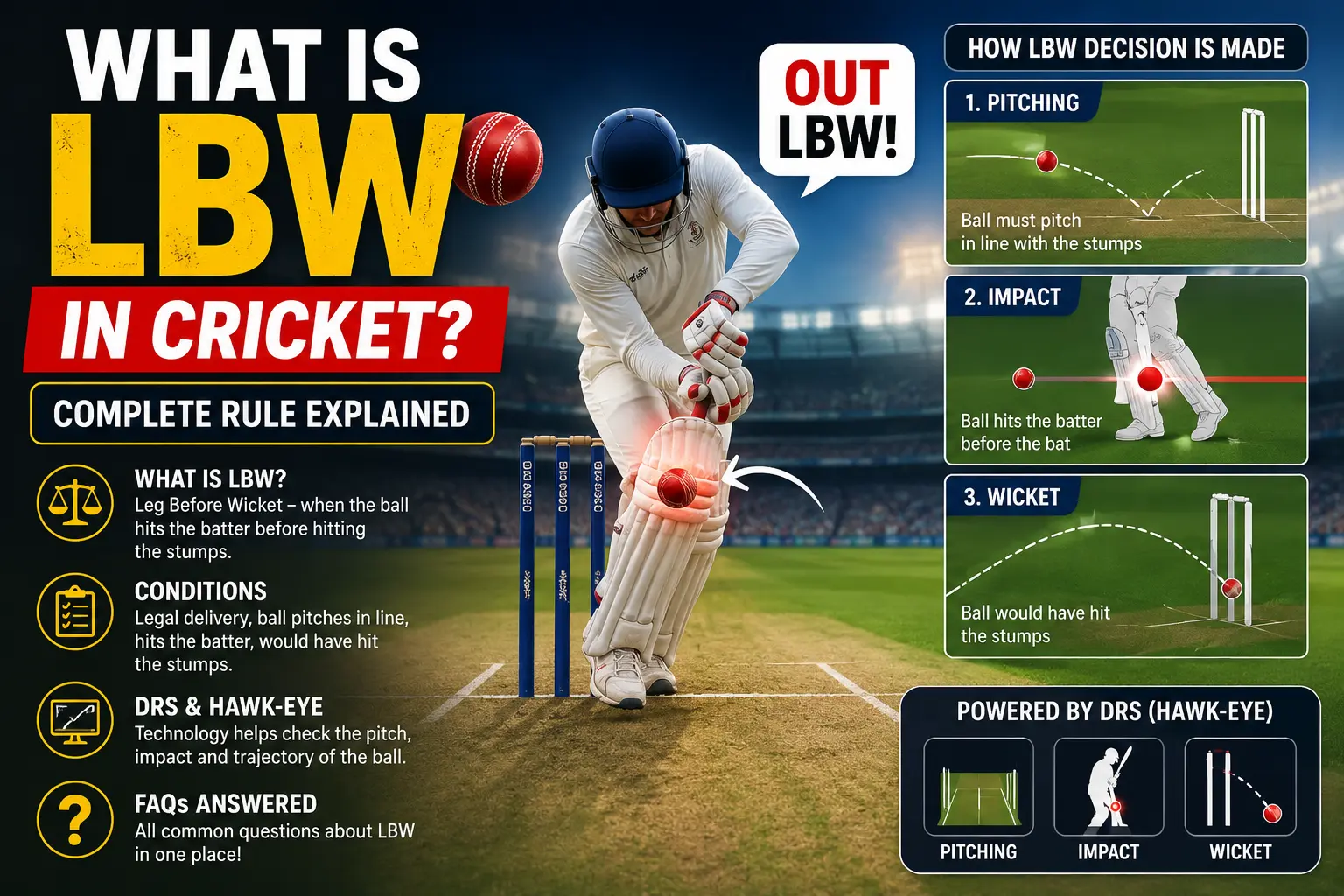
Cricket is a game filled with unique rules, and one of the most misunderstood among them is LBW in cricket, which stands for Leg Before Wicket. Whether you’re a new cricket fan or someone trying to understand umpire decisions better, learning the LBW rule is essential because it is one of the most common ways a batter can get out.
The LBW rule in cricket often creates debate among players, commentators, and fans because it involves several conditions that umpires must consider before giving a batter out. With modern technologies such as DRS (Decision Review System), understanding LBW has become even more important.
In this detailed guide, you’ll learn what LBW means, how the rule works, the conditions for an LBW dismissal, exceptions, DRS involvement, and frequently asked questions.
What Does LBW Mean in Cricket?
LBW stands for Leg Before Wicket.
A batter is given out LBW when the ball strikes any part of their body (usually the leg) before hitting the bat, and the umpire determines that the ball would have gone on to hit the stumps.
The purpose of the rule is to prevent batters from unfairly using their body to block the ball from hitting the wicket.
Without the LBW rule, batters could simply stand in front of the stumps and stop the ball with their legs, making it difficult for bowlers to dismiss them.
Did You Know :- How Many Creases Are There in Cricket? A Complete Detailed Guide
History of the LBW Rule
The LBW law has existed in cricket for centuries.
It was introduced to stop batters from deliberately using their legs to protect the stumps. Over time, the rule evolved and became more detailed as cricket developed.
Today, the LBW law is governed by the Marylebone Cricket Club (MCC), which maintains the official Laws of Cricket.
Modern technology such as Hawk-Eye and ball-tracking systems has significantly improved the accuracy of LBW decisions.
How Does LBW Work?
For a batter to be given out LBW, several conditions must be satisfied.
The umpire cannot simply give a batter out because the ball hit their leg.
Instead, the umpire must carefully analyze the entire delivery.
Conditions for an LBW Dismissal
The following conditions generally need to be met:
1. The Ball Must Be a Legal Delivery
The delivery must not be a no-ball.
If the bowler bowls a no-ball, the batter cannot be dismissed LBW regardless of what happens afterward.
Example
If the bowler oversteps the crease and the ball hits the batter’s pad in front of the stumps, the batter cannot be out LBW.
2. The Ball Must Not Pitch Outside Leg Stump
This is one of the most important LBW rules.
If the ball bounces outside the line of the leg stump before striking the batter, the batter cannot be given out LBW.
Why?
This rule prevents bowlers from unfairly targeting the batter’s legs from a wide angle.
Example
A left-arm spinner bowls around the wicket and the ball pitches well outside leg stump.
Even if the ball hits the batter’s pad and appears to be heading toward the stumps, the batter is not out.
3. The Ball Must Strike the Batter Before Hitting the Bat
The ball must hit the batter’s body first.
If the ball touches the bat before striking the pad or leg, LBW cannot be given.
Common Body Parts Involved
- Pad
- Leg
- Knee
- Thigh
- Arm (under certain circumstances)
Although “leg” is in the name, LBW can involve other parts of the body as well.
4. Impact Must Be in Line or Outside Off Stump
The position where the ball strikes the batter is crucial.
If the Batter Is Playing a Shot
The batter can be out if:
- Impact is in line with the stumps.
- Impact is outside off stump.
- Ball would have hit the stumps.
If the Batter Is Not Playing a Shot
The batter can be out even if the impact is outside off stump, provided the ball would have gone on to hit the wicket.
This is an important distinction in modern umpiring decisions.
5. The Ball Must Be Going on to Hit the Stumps
This is the final and most critical requirement.
The umpire must believe the ball would have hit:
- Off stump
- Middle stump
- Leg stump
If the ball is missing the stumps, the batter cannot be given out.
Also Read :- How Many Wickets Constitute a Double Hat-Trick?
Understanding LBW with a Simple Example
Imagine the following situation:
- Fast bowler delivers the ball.
- Ball pitches in line with the stumps.
- Batter misses the shot.
- Ball strikes the front pad.
- Ball tracking shows it would hit middle stump.
Result
The batter is OUT LBW.
This is a textbook example of a Leg Before Wicket dismissal.
Situations Where a Batter Cannot Be Out LBW
Many fans get confused about these exceptions.
A batter cannot be out LBW if:
The Ball Pitches Outside Leg Stump
Automatic not out.
The Ball Hits the Bat First
LBW does not apply.
The Ball Is Missing the Stumps
Not out.
The Delivery Is a No-Ball
Not out.
The Ball Would Pass Over the Stumps
Not out.
These exceptions are frequently seen during DRS reviews.
What Role Does DRS Play in LBW Decisions?
The Decision Review System (DRS) has transformed LBW decisions.
When players disagree with an umpire’s call, they can request a review.
Technology then analyzes:
- Pitching location
- Point of impact
- Predicted ball path
Hawk-Eye Technology
Hawk-Eye is the ball-tracking system used in international cricket.
It predicts where the ball would have traveled after hitting the batter.
This helps determine whether the delivery would have struck the stumps.
What Is Umpire’s Call in LBW?
One of the most discussed aspects of DRS is Umpire’s Call.
This occurs when the ball-tracking prediction is extremely close.
Example
If only a small portion of the ball is projected to hit the stumps, the original umpire’s decision remains.
Therefore:
- Given out → remains out.
- Given not out → remains not out.
This rule helps preserve the authority of on-field umpires.
Check It :- What Is Bowling Crease in Cricket? Meaning, Rules & Importance Explained
Why Is LBW Important in Cricket?
LBW is one of the most important dismissal methods because it:
- Protects bowlers from unfair blocking.
- Encourages proper batting technique.
- Maintains balance between bat and ball.
- Adds strategic complexity to the game.
Without the LBW law, batting would become significantly easier.
Famous LBW Dismissals in Cricket History
Many legendary matches have featured controversial LBW decisions.
Some of the greatest bowlers have built careers around trapping batters LBW, including:
- Shane Warne
- Muttiah Muralitharan
- Glenn McGrath
- Dale Steyn
- Jasprit Bumrah
- Ravichandran Ashwin
Their ability to move the ball into the batter often results in LBW opportunities.
Tips for Batters to Avoid LBW
Professional batters use several techniques to reduce LBW risk.
Watch the Ball Carefully
Early judgment helps players position themselves correctly.
Use the Bat First
Getting the bat in front of the pad can prevent LBW.
Move the Feet
Good footwork helps batters get into better positions.
Understand the Bowler
Reading swing and spin early improves decision-making.
Also Read :- how many players are in a cricket team? – Complete Guide
Common LBW Mistakes Made by Beginners
New cricket fans often misunderstand the LBW law.
Mistake 1
Thinking any ball that hits the pad is out.
This is incorrect because multiple conditions must be met.
Mistake 2
Believing only the leg can cause LBW.
The ball can strike other body parts too.
Mistake 3
Ignoring where the ball pitched.
Pitching location is one of the most important factors.
LBW in Test, ODI, and T20 Cricket
The LBW rule remains the same across all formats.
Test Cricket
Often features more LBW dismissals because bowlers have more time to set up batters.
ODI Cricket
LBW remains an important wicket-taking option, especially in middle overs.
T20 Cricket
Batters play aggressively, increasing the chances of being trapped LBW.
Conclusion
The LBW rule in cricket is one of the sport’s most important and fascinating laws. It ensures fairness by preventing batters from using their body to block the ball from hitting the stumps.
For a batter to be out LBW, several conditions must be satisfied, including the pitching location, point of impact, and whether the ball would have gone on to hit the wicket. Modern technologies such as DRS and Hawk-Eye have made LBW decisions more accurate than ever before.
Whether you’re watching Test cricket, ODIs, T20Is, or franchise leagues like the IPL, understanding LBW will help you appreciate the game and follow umpiring decisions with greater confidence.
FAQs About LBW in Cricket
1. What does LBW stand for in cricket?
LBW stands for Leg Before Wicket, a method of dismissal where the batter blocks a ball that would otherwise have hit the stumps.
2. Can a batter be out LBW if the ball pitches outside leg stump?
No. If the ball pitches outside leg stump, the batter cannot be given out LBW.
3. Can a batter be out LBW if the ball hits the bat first?
No. The ball must strike the batter’s body before touching the bat for LBW to apply.
4. What is the most important condition for an LBW dismissal?
The ball must be projected to hit the stumps after striking the batter.
5. Can a batter be out LBW on a no-ball?
No. A batter cannot be dismissed LBW from a no-ball delivery.
6. What is Umpire’s Call in LBW?
Umpire’s Call occurs when ball-tracking shows a marginal decision. In such cases, the original on-field decision stands.
7. Does DRS help in LBW decisions?
Yes. DRS uses technologies like Hawk-Eye to determine whether the ball would have hit the stumps.
8. Which bowlers get the most LBW wickets?
Swing bowlers, seam bowlers, and spinners who can move the ball into the batter are often successful at taking LBW wickets.
9. Can a batter be out LBW while attempting a shot?
Yes. A batter can still be out LBW if all conditions of the law are satisfied.
10. Is the LBW rule the same in Test, ODI, and T20 cricket?
Yes. The official LBW law applies equally across all formats of cricket.