
Cricket is a game of precision, rules, and fine margins. While most fans focus on runs, wickets, and sixes, some of the most important elements of the game are the lines drawn on the pitch, known as creases. These creases decide whether a batter is safe, whether a delivery is legal, and whether a dismissal is valid.
So the simple question is: How many creases are there in cricket?
The detailed answer explains how the game actually works.
In this in-depth article, you’ll learn:
-
How many creases exist in cricket
-
The types of creases and their exact roles
-
How creases affect batting, bowling, and umpiring decisions
-
Common misconceptions about creases
-
Their importance in modern cricket and technology
How Many Creases Are There in Cricket?
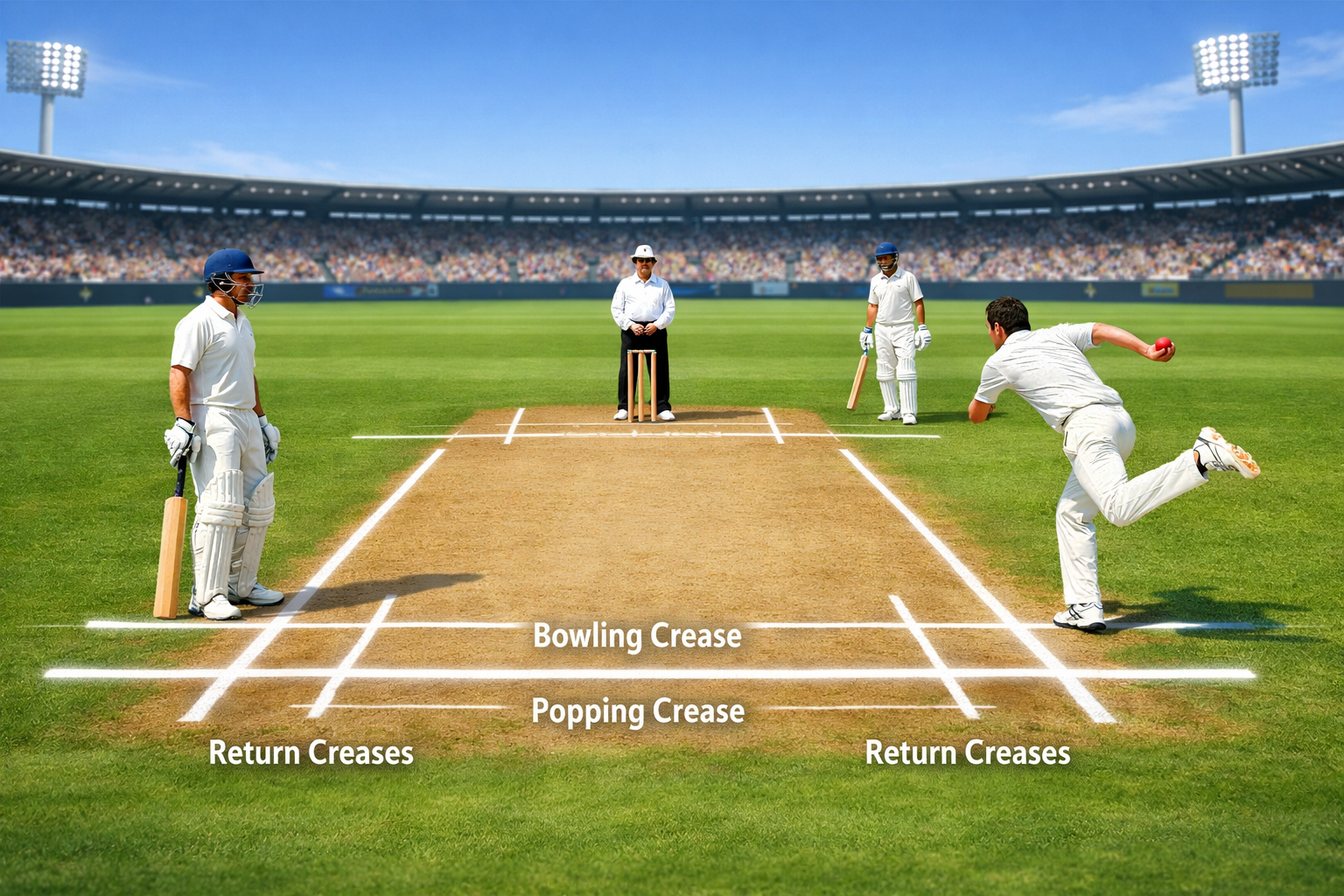
In cricket, there are three main creases at each end of the pitch:
-
Bowling Crease
-
Popping Crease
-
Return Crease
Since a cricket pitch has two ends, the total number of creases on a pitch is:
👉 6 creases in total (3 at each end)
However, when people ask “how many creases are there in cricket,” they usually mean the three types of creases, not counting both ends separately.
Also Read :- क्रिकेट में 4 क्रीज कौन सी हैं? पूरी जानकारी हिंदी में
Understanding the Cricket Pitch Layout
Before diving deeper, it’s important to understand where creases are located.
-
A cricket pitch is 22 yards (20.12 meters) long
-
At both ends of the pitch, a set of three creases is marked
-
These creases are drawn with white lines and are part of the official Laws of Cricket
Each crease has a specific purpose and plays a role in almost every ball bowled.
The Three Types of Creases in Cricket
1. Bowling Crease
What Is the Bowling Crease?
The bowling crease is the most important crease on the pitch. It is the line on which the stumps are placed.
-
It runs horizontally across the pitch
-
The middle stump is placed exactly at the center of this crease
-
It is 8 feet 8 inches (2.64 meters) long
Purpose of the Bowling Crease
The bowling crease serves multiple purposes:
-
Defines the position of the stumps
-
Helps umpires judge run-outs, stumpings, and hit-wicket dismissals
-
Acts as a reference point for the return creases
Without the bowling crease, many dismissal decisions would be impossible.
Bowling Crease and Dismissals
The bowling crease is crucial in deciding:
-
Bowled: The ball must hit the stumps on the bowling crease
-
Stumped: The batter must be outside the crease when the wicket is broken
-
Run-out: The bat or body must be grounded behind the crease
2. Popping Crease
What Is the Popping Crease?
The popping crease is drawn parallel to the bowling crease, 4 feet (1.22 meters) in front of it.
This crease is best known because:
-
It determines whether a batter is safe or out
-
It decides whether a delivery is legal or a no-ball
Purpose of the Popping Crease
The popping crease is used to:
-
Judge run-outs
-
Decide stumpings
-
Check no-balls for overstepping by the bowler
For a batter:
-
If any part of the bat or foot is grounded behind the popping crease, the batter is safe
For a bowler:
-
If the front foot crosses the popping crease, it is a no-ball
Did You Know :- Sunrisers Hyderabad vs Mumbai Indians Timeline
Importance in Modern Cricket
With the introduction of:
-
Third umpires
-
Ball-tracking
-
Front-foot no-ball technology
The popping crease has become even more important in today’s game.
3. Return Crease
What Is the Return Crease?
The return creases are two vertical lines drawn perpendicular to the bowling crease.
-
One on the off-side
-
One on the leg-side
They form the sides of the bowling area.
Purpose of the Return Crease
Return creases are used to:
-
Define the legal area for the bowler’s delivery stride
-
Ensure the bowler does not bowl too wide or from an unfair angle
If a bowler’s back foot goes outside the return crease:
-
The delivery is declared a no-ball
How Many Return Creases Are There?
At each end:
-
There are two return creases
But they are considered one type of crease, not a separate category.
Did You Know :- सभी फॉर्मेट में शतक लगाने वाला पहला भारतीय खिलाड़ी कौन है?
Total Number of Creases in Cricket
Let’s summarize clearly:
At One End of the Pitch:
-
1 Bowling Crease
-
1 Popping Crease
-
2 Return Creases
➡️ 4 lines, but 3 types of creases
On the Entire Pitch:
-
3 creases × 2 ends = 6 creases
Why Are Creases So Important in Cricket?
Creases are not just lines — they control the game.
Role of Creases in Batting
-
Decide whether a batter is in or out
-
Help batters judge running between wickets
-
Essential for grounding the bat safely
Role of Creases in Bowling
-
Decide no-balls
-
Ensure fair delivery angles
-
Maintain balance between batter and bowler
Role of Creases in Umpiring
-
Key reference points for decisions
-
Used in video replays and DRS
-
Crucial for consistency and fairness
Common Misconceptions About Cricket Creases
Misconception 1: There Are Only Two Creases
❌ Wrong
There are three types of creases at each end.
Misconception 2: Only the Popping Crease Matters
❌ Wrong
All creases play a role — especially in no-ball and dismissal decisions.
Misconception 3: Return Creases Are Not Important
❌ Wrong
Return creases ensure bowlers do not gain unfair advantage.
Creases and Technology in Modern Cricket
With modern tools like:
-
Hawk-Eye
-
UltraEdge
-
Front-foot no-ball cameras
Creases have become digitally monitored.
-
Even a millimeter over the popping crease can result in a no-ball
-
Run-outs are decided using zoomed-in crease angles
This shows how vital accurate crease markings are.
Differences Between Creases in Test, ODI, and T20 Cricket
Interestingly:
-
The number and function of creases remain the same in all formats
-
Only the playing conditions change, not crease laws
So whether it’s:
-
Test cricket
-
One Day Internationals
-
T20 matches
➡️ The creases stay exactly the same.
Historical Evolution of Cricket Creases
-
Early cricket had less standardized markings
-
Over time, MCC standardized crease measurements
-
Today, creases are defined precisely in the Laws of Cricket
This evolution helped make cricket more fair and professional.
Read This :- Mumbai Indians Ka Baap Kaun Hai Puri Jaankari
Conclusion
So, how many creases are there in cricket?
-
There are three types of creases:
-
Bowling crease
-
Popping crease
-
Return crease
-
-
At both ends combined, there are six creases in total
Creases are the foundation of cricket rules. They control:
-
Fair play
-
Legal deliveries
-
Run-outs and stumpings
-
Modern umpiring decisions
Without creases, cricket simply cannot function as a structured sport.
Understanding creases doesn’t just improve your knowledge — it makes watching and playing cricket far more enjoyable.
Frequently Asked Questions (FAQs)
Q1. How many creases are there at one end of a cricket pitch?
There are three types of creases at one end: bowling, popping, and return creases.
Q2. How many creases are there in total on a cricket pitch?
There are six creases in total, with three at each end.
Q3. Which crease decides a no-ball?
The popping crease (front foot) and return crease (back foot) decide no-balls.
Q4. Is the batting crease the same as the popping crease?
Yes, the batting crease is commonly referred to as the popping crease.
Q5. Are creases the same in all cricket formats?
Yes, creases are the same in Test, ODI, and T20 cricket.
Q6. Can a batter be out if the bat is in the air above the crease?
Yes. The bat or foot must be grounded behind the crease to be safe.