

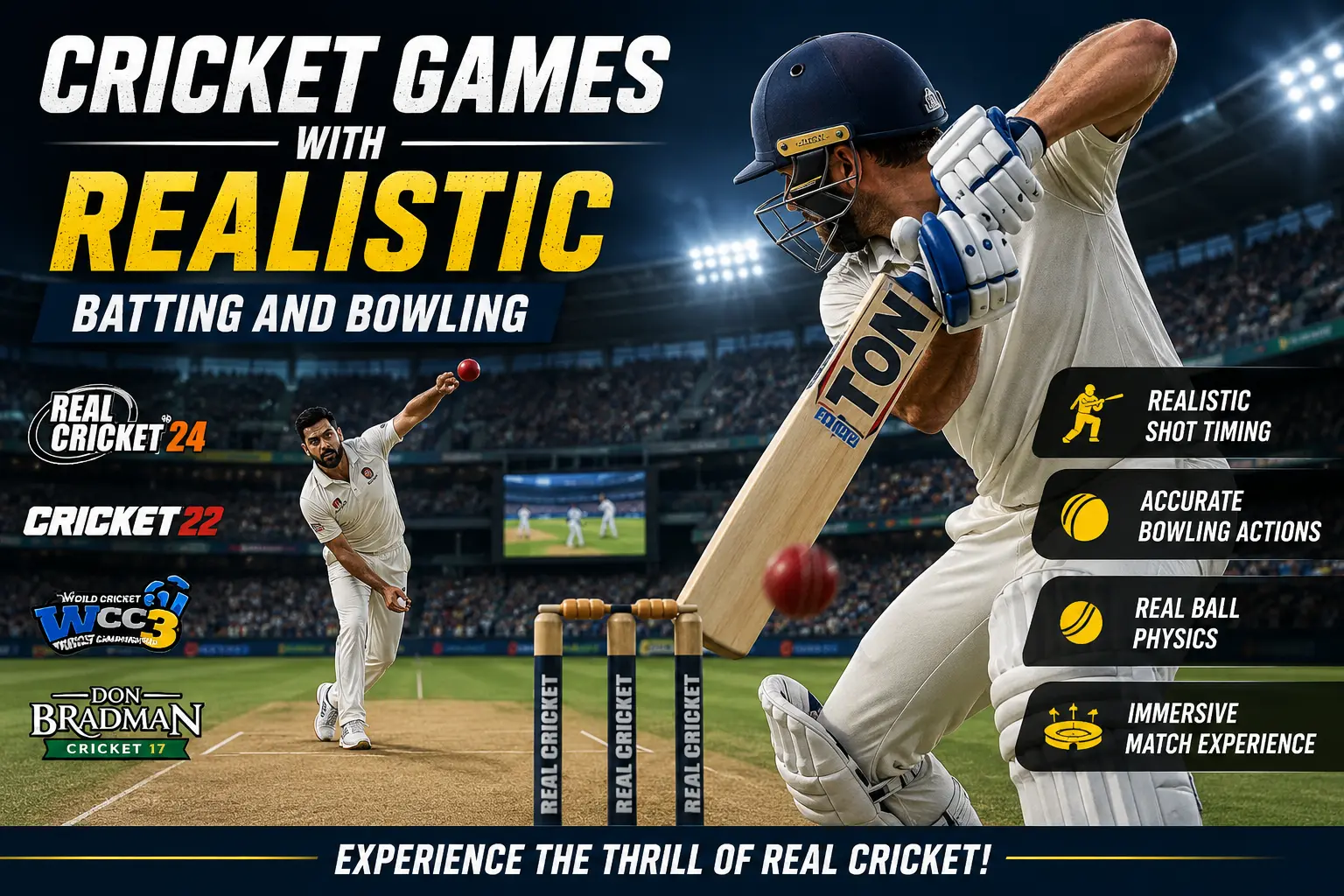
Cricket is a game of small margins — the angle of a bat face, the seam position on a fast ball, the split-second decision to go for a cut shot or leave it alone. For decades, video game developers struggled to translate that nuance onto a screen. Early cricket games reduced batting to a timing bar and bowling to a power meter, and the results felt more like arcade mini-games than cricket.
That has changed dramatically. Today’s cricket games with realistic batting and bowling use motion-captured animations, physics-driven ball trajectories, dynamic pitch conditions, and genuinely skill-based controls that reward players who understand shot selection, field placement, and bowling variations. Whether you’re on PC, console, or mobile, there is now a genuine simulation experience waiting for you.
This guide breaks down the best realistic cricket simulation games available right now, compares their batting and bowling systems in detail, and helps you pick the right title based on your platform, skill level, and how deep you want the simulation to go.
Why “Realistic” Batting and Bowling Actually Matters
Before ranking games, it’s worth understanding what separates a genuinely realistic cricket game from an arcade cricket game. When reviewers and players talk about realistic batting and bowling mechanics, they usually mean a combination of the following:
- Shot-timing precision — the bat has to meet the ball within a narrow window, and mistiming produces edges, mishits, or being bowled, not just a weaker version of the same shot.
- Footwork and shot selection — realistic games let you choose front-foot or back-foot play, and reward correct shot selection against different deliveries (yorkers, bouncers, googlies).
- Bowling variation systems — swing, seam, pace changes, and multiple types of spin (leg-spin, off-spin, doosra, googly) that genuinely change how the ball behaves off the pitch.
- Pitch and weather simulation — wickets that deteriorate over a Test match, dew factor in day-night games, and swing that behaves differently under overcast skies.
- Motion-captured animations — hundreds of individual batting and bowling animations recorded from real players so that shots and deliveries look and move like they would on a real field.
- Fielding and appeal realism — diving catches, run-outs, DRS reviews, and umpire decisions that mirror actual match situations.
Games that combine most or all of these elements earn the label of a true cricket simulation game, while titles that rely purely on swipe gestures and simplified timing bars are better described as arcade or casual cricket games — still fun, but not built around realism.
A Short History: How Cricket Game Controls Became Realistic
It helps to understand where today’s realistic cricket simulation games came from, because the evolution of batting and bowling controls explains why current titles feel so different from the cricket games of a decade or two ago.
Early cricket video games in the 1990s and 2000s relied almost entirely on simple button presses — press a button to bowl, press another to swing the bat, and the game would calculate an outcome with minimal player input beyond timing. These games were fun in short bursts but had little room for genuine skill development, since shot direction and bowling line were often fixed or only loosely controllable.
The real shift began with titles built specifically around cricket’s technical detail rather than treating it as a generic sports template. Big Ant Studios’ Don Bradman Cricket series, which eventually evolved into Cricket 19, Cricket 22, and Cricket 24, was one of the first to separate front-foot and back-foot batting, introduce distinct bowling run-ups and release points for different bowler types, and simulate pitch wear across a five-day Test match. On mobile, developers behind Real Cricket and WCC3 began layering swipe-based directional control on top of motion-captured animation libraries, letting touchscreen players approximate the same front-foot/back-foot decision-making that console players were getting with analog sticks and timing windows.
The introduction of “aftertouch” bowling — the ability to subtly adjust a delivery’s line and length after release — was a particularly important step, because it let bowlers correct for a slightly mistimed release the way real bowlers adjust their wrist position mid-delivery. Combined with motion capture for hundreds of individual batting shots, these systems moved cricket games from broad approximations of the sport into genuine simulations where cricketing knowledge — reading a bowler’s variation, choosing the correct shot for a particular delivery — actually matters to the outcome.
What Makes Bowling Feel Realistic: A Closer Look
Bowling is often the harder half of cricket to simulate convincingly, because a real bowler’s effectiveness depends on subtle variables: seam position, wrist angle, pace changes, and how all of that interacts with pitch conditions and weather. The strongest cricket games with realistic bowling mechanics tend to share several specific features:
- Distinct bowler archetypes — fast bowlers, medium pacers, and various types of spinners (leg-spin, off-spin, left-arm orthodox, wrist-spin) each have their own animation sets and effective ranges, rather than sharing one generic delivery model.
- Swing and seam that respond to conditions — overcast weather, a new ball, and humidity should genuinely increase swing, while an older, rougher ball should favor reverse swing or spin grip.
- Variation deliveries with real risk — yorkers, slower balls, googlies, and doosras should be harder to execute correctly and should carry a real chance of going wrong (a leg-side full toss, a long-hop) if mistimed, rather than simply being a cosmetic animation change.
- Pitch deterioration over time — in Test match modes, cracks and rough patches should develop across five days, making spin more effective later in a match, mirroring how real pitches behave.
Games like Cricket 24 and Cricket 22 model most of these systems directly, which is why they’re consistently cited as the deepest bowling engines in the genre, even by reviewers who found other aspects of the games less impressive.
Tips for Getting the Most Out of Realistic Cricket Games
Because these games reward cricketing knowledge rather than just reflexes, a few general habits will help you improve quickly, regardless of which title you choose:
- Learn to read the bowler’s run-up and release, not just the ball after it leaves the hand: In the more realistic titles, bowler animations often hint at pace and variation before the delivery is released.
- Practice front-foot and back-foot shot selection separately: Most realistic batting systems punish players who try to play every ball with the same footwork, especially against short-pitched bowling or full deliveries.
- Use bowling variations sparingly and situationally: Constantly bowling yorkers or googlies in these engines usually increases your risk of a bad delivery — save your best variations for set batters or key moments.
- Pay attention to pitch and weather indicators before a match, especially in Test match or multi-day formats, since swing and spin effectiveness can shift significantly depending on conditions.
- Don’t ignore fielding placement: In games like Real Cricket 24 and Cricket 24, manual or semi-manual field settings can meaningfully change how many boundaries you concede, which matters as much as raw bowling skill.
The Best Cricket Games With Realistic Batting and Bowling in 2026
1. Cricket 24 (PC, PlayStation, Xbox, Switch) — The Benchmark PC/Console Simulation
Developed by Big Ant Studios and published by Nacon, Cricket 24 is the eighth entry in the studio’s long-running cricket series and remains the most complete console and PC cricket simulation on the market. The game includes over 200 real players rendered through full photogrammetry, alongside licensed national teams including Australia, England, Pakistan, West Indies, New Zealand, and Ireland.
What makes Cricket 24 stand out as one of the top cricket games with realistic batting and bowling is its dedicated “Aftertouch” and timing-based control system, which lets players fine-tune shot direction and bowling line even after release, adding a genuine layer of skill on top of raw timing. The batting system separates front-foot and back-foot shots, and bowling includes multiple pace variations plus a full spin-bowling toolkit with drift, dip, and turn modeled individually for each bowler.
Career mode is a major draw for players who want long-term progression: you can build a player from domestic cricket all the way to full international honors, training specific attributes and managing form and fitness along the way. The game also offers a franchise tournament mode and supports both men’s and women’s international cricket with equal depth.
It’s worth noting that critical reception for Cricket 24 has been mixed — several reviewers pointed out that the visual upgrades and UI changes over its predecessor, Cricket 22, were modest, and that some bugs and glitches persisted at launch. Even so, the underlying batting and bowling engine, refined across nearly a decade of Big Ant Studios cricket titles (going back to Don Bradman Cricket), remains widely regarded as the deepest and most technically accurate cricket simulation available on PC and consoles.
Best for: PC/console players who want a full career mode, licensed international teams, and the deepest bowling-variation system available in any cricket game today.
2. Cricket 22: The Official Game of the Ashes — Still Holding Up
Cricket 22, Cricket 24’s direct predecessor, remains relevant even years after release because the two games share the same core engine. Cricket 22 introduced an arcade-friendly control layer on top of its simulation mechanics, including an “after-touch” feature that lets you adjust a delivery’s direction even after it leaves the bowler’s hand — a system Cricket 24 later inherited.
For players deciding between the two, Cricket 22 is often the more stable and bug-free experience, with a narrative-driven career mode, competitions like the Ashes and the Big Bash League, and refined commentary. If you already own Cricket 22 and are satisfied with its batting and bowling depth, several reviewers note there’s limited incentive to immediately upgrade to Cricket 24, since the fundamentals of shot timing and bowling variation are nearly identical between the two titles.
Best for: Budget-conscious PC players who want nearly the same simulation depth as Cricket 24 at a lower price point.
3. World Cricket Championship 3 (WCC3) — Mobile’s Most Complete Simulation
On mobile, World Cricket Championship 3 is consistently ranked as one of the best realistic cricket games for Android and iOS. WCC3 uses meticulously captured full-motion animations for batting, bowling, and fielding, and pairs them with professional-style commentary that reacts to what’s happening on the field.
The batting system in WCC3 supports a wide shot range with swipe-based directional control, while the bowling system includes multiple pace options, swing, and a full range of spin deliveries. The game covers all three major formats — T20, ODI, and Test cricket — and includes major tournament licenses like the Cricket World Cup and the Ashes, giving it more competitive structure than most mobile cricket titles.
WCC3’s controls are generally considered more accessible than Real Cricket’s, trading a small amount of mechanical depth for smoother pick-up-and-play sessions, which makes it a strong choice for players who want realism without a steep learning curve.
Best for: Mobile players who want console-adjacent realism with simpler, more accessible controls.
4. Real Cricket 24 — Motion-Capture Realism on Mobile
Developed by Krafton (the studio behind Battlegrounds India), Real Cricket has built its reputation on motion-capture technology that replicates diving catches, umpire appeals, and full batting and bowling animation cycles. Real Cricket 24 pushes this further with a batting system built around more than 700 individual shots, combined with motion-captured fielding and realistic catching cues that go beyond what most competing mobile titles offer.
Bowling isn’t reduced to a single swipe gesture — players actively have to out-think the batter using pace changes and spin variations rather than simply “pitching it up,” which is a meaningful step toward genuine skill-based bowling on a touchscreen. Real Cricket 24 also includes official licensing for several IPL franchises, meaning matches feature accurate jerseys, kits, and rosters rather than generic placeholder teams.
The manual fielding system is a standout differentiator versus WCC3 — where WCC3 automates much of the fielding, Real Cricket gives players direct control, adding another layer of realism (and difficulty) to the overall experience.
Best for: Mobile players who want the deepest shot-selection system and manual fielding control available on a phone.
5. Cricket Captain 2026 — Realism Through Strategy, Not Direct Control
Not every player wants to control every ball themselves. Cricket Captain 2026 approaches realism from the management side: instead of directly playing shots or bowling deliveries, you make tactical decisions — team selection, bowling changes, field placements, batting order — and the simulation engine resolves outcomes based on player attributes, form, and match conditions.
This makes Cricket Captain 2026 less about mechanical batting and bowling skill and more about strategic realism: reading match situations, managing a squad across a long season, and making the kind of decisions a real captain or coach would face. For fans who find direct-control batting mechanics less appealing than the tactical side of the sport, it fills a niche that Cricket 24 and Real Cricket don’t cover.
Best for: Strategy fans who want a realistic cricket experience built around tactics and squad management rather than manual batting and bowling.
6. Hitwicket — Realistic Systems Meet Team-Building
Hitwicket blends a responsive batting and bowling engine with deep team-building mechanics, including real-time player auctions that let you assemble a squad the way a franchise owner would. It supports short-format tournaments and recreates the intensity of major cricket leagues and historic rivalries, combining the strategic depth of a manager game with match-by-match batting and bowling control.
Best for: Players who want the hybrid of a cricket manager game and hands-on match control in a single mobile title.
7. Cricket League — Fast, Motion-Captured, and Casual-Friendly
Cricket League (from Miniclip) leans toward faster, shorter matches but still incorporates hundreds of motion-captured animations that make individual shots and deliveries look natural rather than repetitive. It supports official IPL team licensing, multiple formats including Pro T20 campaigns, and straightforward controls that make it approachable for newer players without abandoning realistic presentation.
Its main trade-off is depth — Cricket League’s session length and monetization model (it leans noticeably pay-to-win in places) mean it won’t satisfy players looking for a full career-mode simulation, but the underlying animation and bowling-variation systems are more sophisticated than typical arcade cricket apps.
Best for: Players who want realistic-looking cricket in short, commute-friendly sessions.
Comparing the Batting and Bowling Systems Side by Side
| Game | Platform | Batting Depth | Bowling Depth | Career Mode | Licensing |
|---|---|---|---|---|---|
| Cricket 24 | PC/Console | Very High | Very High | Yes, deep | International teams |
| Cricket 22 | PC | Very High | Very High | Yes, narrative-driven | Ashes, Big Bash |
| WCC3 | Mobile | High | High | Yes | World Cup, Ashes |
| Real Cricket 24 | Mobile | Very High (700+ shots) | High | Yes | IPL franchises |
| Cricket Captain 2026 | PC | Strategic (indirect) | Strategic (indirect) | Full season-based | Domestic/international |
| Hitwicket | Mobile | Moderate-High | Moderate-High | Franchise-based | League-style |
| Cricket League | Mobile | Moderate | Moderate | Limited | IPL teams |
What About Cricket Board Games and Dice-Based Simulations?
If you’re looking for realism away from a screen, tabletop cricket simulation games are also worth a mention. Traditional games like Howzat use dice and card-based systems to recreate batting and bowling outcomes, and more detailed tabletop cricket simulations can model run rates, dismissals, and scoring patterns with surprising statistical accuracy. These won’t replicate the moment-to-moment skill of a video game’s batting and bowling controls, but they offer a genuinely strategic, screen-free way to simulate a full match with friends or family.
How to Choose the Right Realistic Cricket Game for You
With several strong options on the market, the right choice usually comes down to platform and how much control you want over individual deliveries.
- If you own a PC or console and want the deepest simulation available, Cricket 24 (or Cricket 22 if you want a more polished, if slightly older, experience) is the clear choice. Both offer licensed international teams, detailed career progression, and the most technically layered batting and bowling engine in the genre.
- If you’re on mobile and want console-level realism with simpler controls, WCC3 is the safer pick, especially for newer players who still want authentic shot variety and bowling options.
- If you’re on mobile and want the deepest shot-selection and fielding system available on a phone, Real Cricket 24’s 700+ shot batting engine and manual fielding controls are hard to beat.
- If you enjoy the strategic side of cricket more than direct control, Cricket Captain 2026 delivers realism through tactics, squad building, and match management rather than manual batting.
- If you want quick, realistic-looking matches for short sessions, Cricket League and Hitwicket both offer motion-captured presentation without demanding a long-term time investment.
Frequently Asked Questions
Which cricket game has the most realistic batting mechanics?
Real Cricket 24 offers one of the largest shot libraries on mobile, with over 700 individual batting shots and motion-captured animations, while Cricket 24 offers comparable depth on PC and console with its front-foot/back-foot shot system and Aftertouch controls.
What is the most realistic bowling system in a cricket video game?
Cricket 24 and Cricket 22 both feature layered bowling systems that include pace variation, swing, seam movement, and a full range of spin deliveries, giving bowlers meaningful control over how the ball behaves off the pitch — a level of depth that’s difficult to match on mobile.
Is WCC3 more realistic than Real Cricket?
Both are considered top-tier mobile cricket simulations. WCC3 leans toward smoother, more accessible controls, while Real Cricket 24 offers deeper shot selection and manual fielding, making it the more mechanically demanding of the two.
Are cricket manager games like Cricket Captain considered realistic?
Yes, but the realism comes from tactical decision-making rather than direct batting and bowling control. Cricket Captain 2026 simulates outcomes based on player attributes, form, and conditions, making it realistic in a strategic rather than mechanical sense.
Can I play a realistic cricket game offline?
Yes. Several titles, including WCC3, Real Cricket 24, and various mobile cricket apps, offer offline modes that retain realistic batting and bowling mechanics without requiring an internet connection.
Final Thoughts
The gap between arcade cricket games and true simulations has narrowed considerably, but it hasn’t disappeared. What separates the best cricket games with realistic batting and bowling from the rest is a combination of genuine shot and delivery variety, motion-captured presentation, and systems that reward cricketing knowledge rather than just fast reflexes. Cricket 24 and Cricket 22 remain the benchmark for PC and console players, while WCC3 and Real Cricket 24 lead the way on mobile. Whichever platform you’re on, 2026 offers more genuinely realistic cricket experiences than at any point in the genre’s history — so pick the one that matches how deep you want to go, and get ready to face the new ball.
