
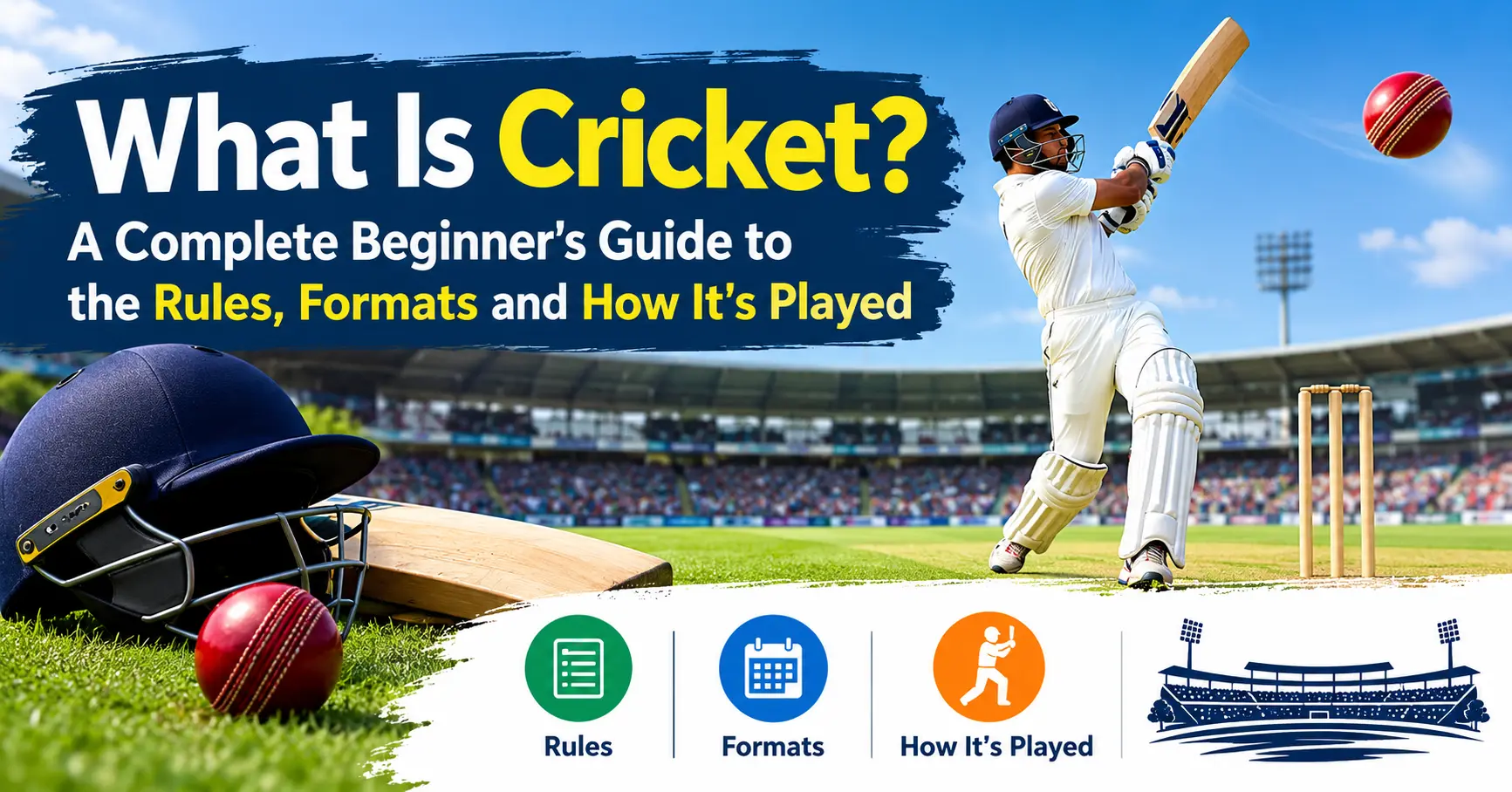
Cricket is the second most-watched sport on the planet, followed by an estimated 2.5 billion people — and yet if you didn’t grow up around it, watching a match can feel genuinely baffling. Players in white standing in a field. A game that sometimes lasts five days and still ends without a winner. Commentators shouting about “silly point” and “googly” and “LBW.”
Here’s the good news: the core of What Is Cricket far simpler than it looks. This guide explains everything from scratch — no jargon assumed, no prior knowledge needed.
What Is Cricket? The Simple Answer
Cricket is a bat-and-ball sport played between two teams of 11 players each. One team bats and tries to score runs; the other team bowls and fields, trying to dismiss the batters and limit scoring. The teams then swap roles. The team that scores more runs wins.
That’s genuinely it. Everything else — the formats, the fielding positions, the unusual terminology — is detail layered on top of that one idea.
The game is played on a large oval field with a rectangular strip in the middle called the pitch, which measures 22 yards (about 20 metres) long. At each end of the pitch sits a set of three wooden stumps with two small bails balanced on top. That structure is called the wicket.
How Cricket Is Played: The Basic Flow
Two batters from the batting team are on the field at any one time, standing at opposite ends of the pitch. All 11 players from the fielding team are on the field.
One fielder — the bowler — delivers the ball toward the batter at the other end. The batter tries to hit it and score runs. The fielding team tries to either get the batter out or stop the ball before runs are scored.
Bowling happens in sets of six deliveries, called an over. After each over, a different bowler takes over from the opposite end of the pitch, and the fielders adjust positions accordingly.
The batting team keeps batting until either 10 of its 11 batters are dismissed (you need two batters on the field, so the innings ends when only one is left) or the allotted overs run out. Then the teams swap.
How Runs Are Scored in Cricket
There are two main ways to score.
Running between the wickets. After hitting the ball, the two batters can run to each other’s ends of the pitch. Each completed exchange is one run. They can run two, three, or occasionally more if the ball travels far enough and fielders are slow to return it.
Boundaries. The field is marked by a rope around its edge. If the ball reaches that rope after bouncing along the ground, the batting team automatically gets four runs. If the ball clears the rope on the full — without bouncing — it’s six runs. Boundaries are the fastest way to score, which is why big hitting dominates shorter formats.
There are also extras — runs awarded for bowling errors. A wide (ball bowled too far from the batter to hit) and a no-ball (an illegal delivery, usually from overstepping the line) each give the batting side a free run, plus the delivery has to be bowled again.
The 10 Ways to Get Out in Cricket
This is where a lot of beginner guides create confusion, so let’s be precise about it.
The Laws of Cricket, maintained by the Marylebone Cricket Club (MCC), officially recognise 10 methods of dismissal under the current code. You’ll see some sources say 11 or even 12 — that’s usually because they either count “Handled the Ball” separately (it was merged into Obstructing the Field in 2017) or list the non-striker run out, sometimes called a “Mankad,” as its own category (it’s officially just a run out).
Here are all 10:
The Five Common Dismissals
1. Bowled — The ball passes the bat and hits the stumps, dislodging at least one bail. The cleanest, least disputed dismissal in cricket: the stumps speak for themselves.
2. Caught — The batter hits the ball with the bat (or the glove holding the bat) and a fielder catches it before it touches the ground. This is by far the most common way to get out. Between 1877 and 2012, caught accounted for 56.9% of all Test match dismissals — 40.6% caught by fielders and 16.3% by the wicket-keeper.
3. LBW (Leg Before Wicket) — The ball hits the batter’s body (usually the pads) and the umpire judges it would have gone on to hit the stumps. Three things must be satisfied: where the ball pitched, where it struck the batter, and whether it was heading for the stumps. It’s the most debated dismissal in the sport, which is why ball-tracking technology now plays such a central role in reviewing it. If you want to understand the LBW rule in detail, including all the conditions and examples, read our complete guide to what is LBW in cricket.
4. Run Out — A fielder breaks the stumps with the ball while a batter is out of their crease (the safe zone) while attempting a run.
5. Stumped — The batter steps out of their crease to play a shot, misses, and the wicket-keeper removes the bails before they get back.
The Five Rare Dismissals
6. Hit Wicket — The batter knocks their own stumps over with bat, body or equipment while playing a shot or setting off for a run.
7. Hit the Ball Twice — The batter deliberately strikes the ball a second time, other than to legitimately defend their wicket. Extremely rare.
8. Obstructing the Field — The batter wilfully obstructs or distracts the fielding side, such as deliberately blocking a throw or interfering with a catch. Since 2017, this law also covers deliberately handling the ball.
9. Timed Out — An incoming batter fails to be ready to face within three minutes of the previous dismissal. Angelo Mathews became the first player ever timed out in international cricket in 2023, in an incident that triggered a huge debate about the spirit of the game.
10. Retired Out — A batter leaves the field without the umpire’s permission and without genuine injury, and doesn’t return with the opposing captain’s consent. This is different from “retired hurt,” which isn’t a dismissal.
Batting, Bowling and Fielding Explained
Batting
The batter’s job is to score runs while protecting their wicket. Good batters play a range of shots — the drive, the cut, the pull, the sweep — chosen based on where the ball pitches and how it behaves.
Batters wear substantial protective equipment: pads, gloves, a helmet, and body protection. That’s not optional caution. A fast bowler can deliver the ball at over 90 mph.
Bowling
Bowlers fall into two broad categories, and understanding the difference makes matches far easier to follow.
Pace bowlers rely on speed and movement. Swing bowlers make the ball curve through the air, while seam bowlers make it deviate off the pitch after bouncing.
Spin bowlers bowl much slower but spin the ball sharply sideways off the pitch using wrist or finger action. A leg-spinner’s stock ball turns one way; the googly is the disguised delivery that turns the other way and is one of cricket’s great deceptions.
One key rule: the bowler must keep their arm straight through the delivery. Bending and straightening the elbow — “chucking” — is illegal.
Fielding
Fielding is where cricket produces some of its most spectacular moments. The fielding captain positions all nine fielders (plus the bowler and wicket-keeper) strategically, and those positions have famously odd names — slip, gully, silly point, fine leg, deep midwicket.
The wicket-keeper is the specialist. Crouching behind the stumps in gloves and pads, they take catches off edges, complete stumpings, and gather deliveries the batter misses.
The Three Formats of Cricket
Cricket is unusual among major sports in having three completely different formats played at international level.
Test Cricket
The longest and oldest format, played over five days with two innings per side. Teams wear traditional whites and use a red ball. Around 90 overs are bowled per day.
Crucially, a Test match can end in a draw if neither side wins within five days — a concept that confuses newcomers but is central to the format’s strategy. Test cricket is widely regarded by purists as the truest examination of skill, temperament and endurance.
One Day Internationals (ODIs)
Each team bats one innings of 50 overs. Coloured clothing, a white ball, and a guaranteed result on the same day. The ODI World Cup is cricket’s flagship tournament.
Twenty20 (T20)
Each team bats one innings of just 20 overs, with a match finishing in around three hours. T20 prioritises aggressive, high-scoring cricket and is the format driving cricket’s global expansion — including its growth in the United States through Major League Cricket.
Quick comparison:
| Format | Overs per side | Innings per side | Duration | Ball |
|---|---|---|---|---|
| Test | Unlimited (~90/day) | 2 | 5 days | Red |
| ODI | 50 | 1 | ~8 hours | White |
| T20 | 20 | 1 | ~3 hours | White |
Umpires and Their Signals
Two on-field umpires control the match, supported by a third umpire who reviews decisions using television replays and ball-tracking technology, plus a match referee who handles conduct issues.
Umpire signals are how decisions get communicated to players, scorers and spectators. The most common ones:
- Four — arm waved horizontally back and forth across the chest
- Six — both arms raised straight above the head
- Out — index finger raised
- Wide — both arms extended straight out sideways
- No-ball — one arm extended out to the side
- Bye — one arm raised straight up, open palm
- Leg bye — umpire taps a raised knee
- Dead ball — arms crossed and uncrossed below the waist
You Can Play Cricket Almost Anywhere
One of cricket’s genuine strengths is how little it actually requires. International matches need stadiums and groundstaff, but the basic game needs a bat, a ball, and something to use as stumps.
Across South Asia, the Caribbean, England, Australia and increasingly the United States, cricket is played in streets, parks, car parks and back gardens, with improvised rules adapted to whatever space is available. Tape-ball cricket, gully cricket, and indoor cricket are all legitimate versions of the sport with huge followings.
Why Cricket Is Growing Globally Right Now
Cricket is entering arguably the most significant expansion phase in its modern history, driven by two developments.
T20 franchise leagues have made the sport commercially viable in new markets, including the United States, where Major League Cricket launched in 2023 and is building permanent cricket infrastructure.
Cricket returns to the Olympics at the 2028 Los Angeles Games — its first Olympic appearance since 1900. For a sport trying to establish itself in America, a home Olympics is an enormous opportunity.
If you want to see how a newer cricket nation is building from the ground up, our guide to the United States national cricket team covers exactly that story — including the fact that the first international cricket match ever played was USA vs Canada in 1844, 33 years before the first Test.
Frequently Asked Questions
What is cricket in simple words?
Cricket is a bat-and-ball game between two teams of 11 players. One team bats and scores runs; the other bowls and fields, trying to dismiss the batters. After the batting team is out or runs out of overs, the teams swap. Whoever scores more runs wins.
How many players are in a cricket team?
Each cricket team has 11 players on the field. Squads usually include substitutes who can field but cannot bat or bowl in most formats.
How many ways can you get out in cricket?
There are 10 official methods of dismissal under the current MCC Laws of Cricket: bowled, caught, LBW, run out, stumped, hit wicket, hit the ball twice, obstructing the field, timed out, and retired out. Some sources say 11 or 12 because they count handled the ball separately (merged into obstructing the field in 2017) or list the non-striker run out as its own category.
What are the 3 formats of cricket?
Test cricket (five days, two innings per side, red ball), One Day Internationals (50 overs per side, white ball), and Twenty20 (20 overs per side, roughly three hours). Each demands different skills and tactics.
Why do cricket matches last 5 days?
Test cricket allows each team two innings with no over limit, which requires time. The five-day structure exists to properly test batting endurance, bowling stamina, and how teams adapt as pitch conditions change. If no team wins in that time, the match is a draw.
How many runs is a boundary in cricket?
Four runs if the ball reaches the boundary rope after bouncing, and six runs if it clears the rope without touching the ground.
What is an over in cricket?
An over is a set of six legal deliveries bowled by one bowler from one end of the pitch. After each over, bowling switches to the opposite end with a different bowler.
How Many Creases Are There in Cricket?
There are four creases at each end of a cricket pitch: one popping crease, one bowling crease, and two return creases. These markings help determine the batter’s position and whether a bowler has delivered the ball legally. If you want to learn more about their purpose, measurements, and exact placement, read our detailed guide on how many creases are there in cricket.
Who makes the rules of cricket?
The Laws of Cricket are written and maintained by the Marylebone Cricket Club (MCC). The International Cricket Council (ICC) then sets additional playing conditions for international matches on top of those Laws.
Is cricket in the Olympics?
Yes. Cricket returns at the 2028 Los Angeles Olympic Games, its first appearance since 1900.
More cricket guides on Cricket Game: United States National Cricket Team: Squad, Schedule & History · Who Is the Best Captain in World Cricket? · For more explainers, team guides and player profiles, visit Cricket Game.