
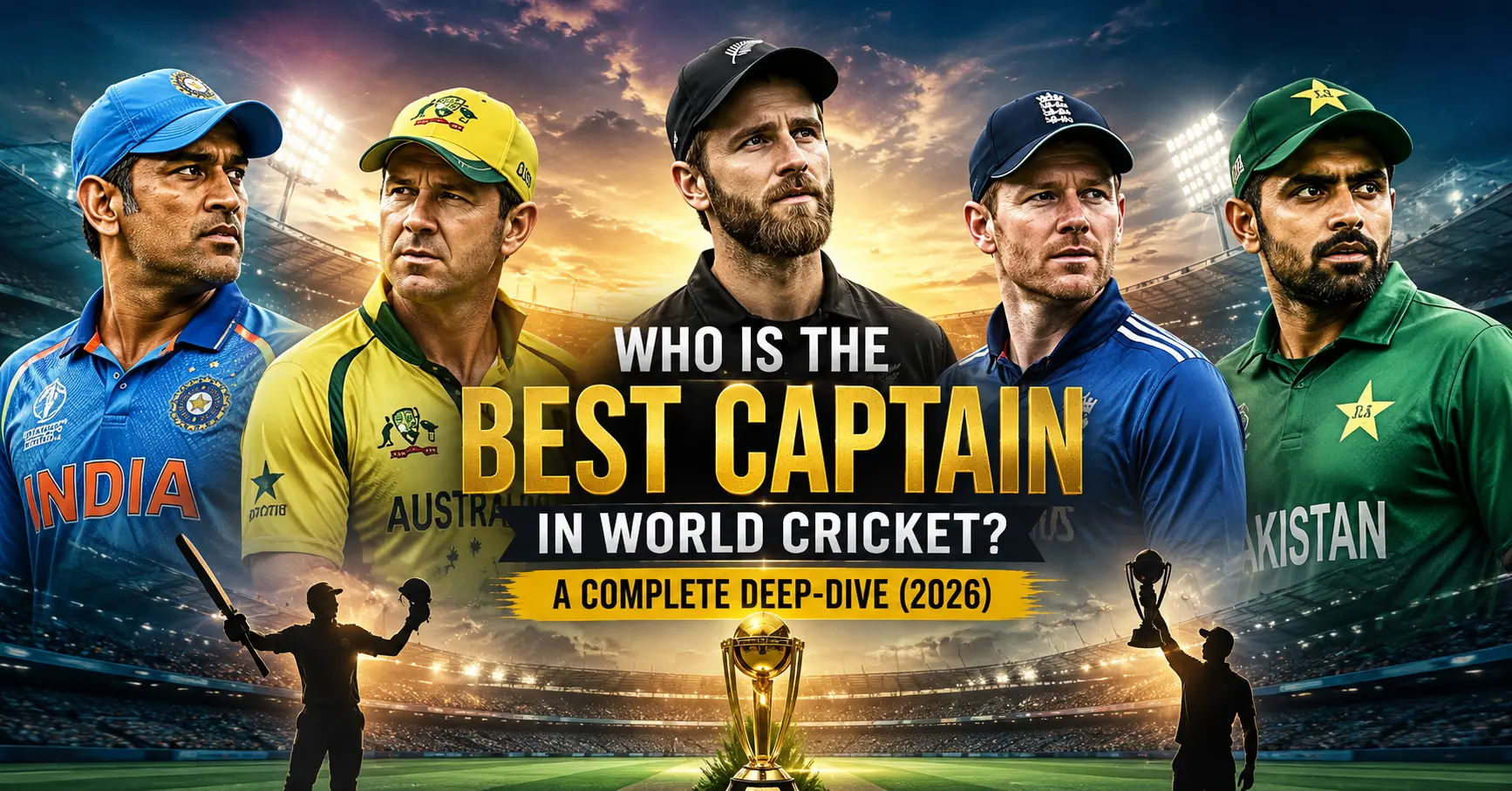
Cricket is unique among team sports. A football manager sets tactics from the sideline. A cricket captain does far more. He sets the field. He changes the bowling. He reads the pitch. He manages egos. And he makes real-time calls every single over, often with a World Cup on the line.
So when fans ask “who is the best captain in world cricket,” they’re really asking something bigger. What separates a great captain from a merely good one? Does the answer change depending on the era or format? This guide breaks the debate down properly. We’ll cover the statistical case for the greatest captains of all time, the strongest active captains right now, and what the numbers actually say once you look past the headlines.
What Actually Makes a Great Cricket Captain?
Before ranking anyone, let’s define what “best” should measure. Fans and analysts don’t always agree here.
Trophies and ICC titles carry the most visible weight. Leading a team to a World Cup or Champions Trophy is something no statistic can fully replace. Win percentage across Tests, ODIs, and T20Is offers a more consistent measure of sustained success. Tactical reading of the game — field placements, bowling changes, batting order decisions under pressure — is harder to quantify. But it’s exactly what separates a great player who happens to captain from a genuinely great leader. And composure under pressure matters in ways stats can’t fully capture. Staying calm when a match slips away, and helping the team refocus, is often what fans remember longest.
The best captains typically excel across more than one of these dimensions. That’s exactly why the debate keeps circling back to the same handful of names.
The Statistical Case: Ricky Ponting’s Numbers Are Hard to Beat
[Image suggestion: Ricky Ponting holding the World Cup trophy — alt text: “ricky ponting cricket captain record”]
If you judge purely on cold statistics, Ricky Ponting has the strongest case of anyone who’s ever captained a cricket team. Ponting won 48 of his 77 Tests as captain. In One Day Internationals, he won 165 of 230 matches — the most ODI wins by any captain in the format’s history, at a win rate of roughly 71.7%.
He led Australia to back-to-back ODI World Cup titles in 2003 and 2007. He added Champions Trophy wins in 2006 and 2009. That gives him four ICC tournament victories as captain, more than any other men’s captain in the sport’s history.
What makes Ponting’s record especially impressive is context. He inherited, then sustained, one of the most dominant eras in cricket history. He managed a dressing room full of genuine superstars — Warne, McGrath, Gilchrist, Hayden — and kept that team winning consistently for nearly a decade. Managing that many elite personalities without the team fracturing is its own leadership skill, separate from tactics alone.
MS Dhoni: The “King of Captains” Case
Shift the debate from pure statistics to trophy diversity and global impact, and MS Dhoni’s case becomes hard to ignore. Dhoni remains the only captain in cricket history to win all three major ICC trophies: the 2007 T20 World Cup, the 2011 ODI World Cup, and the 2013 Champions Trophy. Add five IPL titles with Chennai Super Kings, and Dhoni holds more ICC trophies as captain than any other captain in the sport’s history.
Statistically, Dhoni won 27 Tests and 110 ODIs as India’s captain. That comfortably beats Virat Kohli’s 65 ODI wins in the same role. But what sets Dhoni apart in most rankings isn’t just the trophy count — it’s his composure. He built a reputation for staying calm under pressure and finishing tight matches, to the point where “Captain Cool” became as much a part of his identity as any individual statistic.
He also took over a rebuilding Indian team, rather than inheriting a dominant one. Many analysts weigh this heavily in his favor, compared to captains who inherited already-stacked sides.
The Rest of the All-Time Conversation
A handful of other names consistently appear near the top of “greatest cricket captain” discussions. Each brings a distinct case.
Steve Waugh built one of the most ruthlessly dominant Australian Test sides in history. His win rate sat around 72%, with a squad that stayed near the top of world cricket for over a decade.
Clive Lloyd transformed West Indies into the most feared team in the world through the late 1970s and 1980s. He built that dominance specifically around a fearsome four-pronged pace attack that reshaped how Test cricket was played.
Imran Khan and Kapil Dev each won a single World Cup — 1992 and 1983 respectively — with squads that weren’t pre-tournament favorites. Many analysts consider this more impressive, pound for pound, than winning with an already-dominant team.
Graeme Smith became South Africa’s youngest-ever Test captain at just 22, with only 8 Tests of experience. He went on to lead South Africa to the world’s No. 1 Test ranking — a remarkable trajectory for someone who started so young.
Virat Kohli never won an ICC trophy as India’s captain. But he led India to the top of the Test rankings and a record number of bilateral series wins. His exceptional win ratio keeps him firmly in this conversation, even without the ICC silverware most other names here have.
Who Is the Best Active Captain in 2026?
Narrow the question to right now, in 2026, and the conversation looks noticeably different.
Pat Cummins (Australia)
Cummins remains one of the most statistically and tactically respected active captains in the sport. He led Australia to the 2023 ODI World Cup on home soil, defeating India in the final. He also captained Australia to the 2023 World Test Championship — a rare double.
Cummins is widely seen as one of the smartest tactical captains currently playing. That’s largely because he’s simultaneously an elite performer with the ball, giving him a rare mix of on-field authority and strategic sharpness. He also stepped into the captaincy during a genuinely difficult period for Australian cricket, following major scandals, and steadied the team through it. That’s a leadership test separate from tactics alone.
Shubman Gill (India)
Gill has emerged as arguably the most significant new leadership story in world cricket this year. He currently captains India in both Test and ODI cricket. As of mid-2026, India sits ranked 3rd in Tests and No. 1 in both ODIs and T20Is under his broader leadership era.
In IPL 2026, former Indian international Ambati Rayudu specifically named Gill the standout captain of the season. He cited Gill’s sharp handling of the bowling attack and the consistency he built with Gujarat Titans throughout the campaign. Gill was also set to be named BCCI Cricketer of the Year in March 2026, backed by 1,764 runs across formats at an average of 49. His captaincy tenure is coinciding with some of the best individual form of his career, rather than being weighed down by it.
Other Names Worth Watching
Suryakumar Yadav captains India’s T20I side and led the team to a successful World Cup title defense. A rotating cast of strong IPL captains also shapes the domestic conversation — including Ajinkya Rahane’s resurgent Kolkata Knight Riders leadership and Ruturaj Gaikwad’s ongoing tenure at Chennai Super Kings.
So, Who Actually Is the Best Captain in the World?
Here’s the honest answer: it depends on which question you’re asking.
Want the strongest statistical case of all time? It’s Ricky Ponting. His win percentages, ICC trophy count, and sheer sustained dominance are hard to argue against on paper.
Want the most complete, trophy-diverse legacy with the greatest cultural impact? It’s MS Dhoni. He’s the only captain to win all three major ICC trophies, paired with a reputation for composure that shaped how a generation of young captains think about leadership.
Asking who’s best right now, in 2026? Pat Cummins and Shubman Gill represent the strongest current cases. Cummins brings a rare combination of elite bowling and battle-tested tactical leadership through a difficult era for Australian cricket. Gill brings the sheer scale and speed of his rise across all three formats at once.
No single number settles this debate permanently. That’s part of why it stays one of cricket’s most enduring conversations. But the data makes one thing clear: the best cricket captains, across every era, share tactical sharpness, composure under real pressure, and the ability to get the most out of the players around them — whether that’s a squad full of superstars, or a team nobody expected to win in the first place.
Frequently Asked Questions
Who has the best statistical record as a cricket captain?
Ricky Ponting holds the strongest statistical case. He has 165 ODI wins (a record), a 71.73% ODI win rate, two World Cup titles (2003, 2007), and four total ICC tournament wins as captain — more than any other men’s captain in cricket history.
Who is considered the “king of captains” in cricket?
MS Dhoni most commonly earns this title. He’s the only captain to win all three major ICC trophies — the 2007 T20 World Cup, 2011 ODI World Cup, and 2013 Champions Trophy — alongside five IPL titles with Chennai Super Kings.
Who is the best cricket captain in the world right now, in 2026?
Pat Cummins and Shubman Gill are the two strongest current contenders. Cummins leads Australia with a rare mix of elite fast bowling and tactical sharpness. Gill has rapidly emerged as India’s Test and ODI captain, earning praise across IPL 2026 and international cricket alike.
Has Virat Kohli won any ICC trophies as captain?
No. Virat Kohli did not win an ICC trophy during his tenure as India’s captain, despite leading India to the top of the Test rankings and a record number of bilateral series wins. This remains one of the more debated gaps in his overall captaincy legacy.
What makes a cricket captain great, statistically speaking?
The most common measures include win percentage across formats, total ICC trophies won, tactical decision-making under pressure (field placements, bowling changes, batting order), and the ability to sustain team performance over a long tenure rather than a single standout tournament.
Note: Statistics and rankings referenced in this article reflect publicly available data as of mid-2026. Captaincy roles, team rankings, and active leadership positions can change — always check current ICC and team sources for the latest updates.